
Good Fonts for Logos: 10 Best Logo Fonts by Logo Type
Good fonts for logos stay readable when the mark shrinks to an app icon, look different from the competition, and come with a licence you can build a brand on. A logo font is any typeface used to spell out a brand name, as it comes or as the base for a custom wordmark.
Our top three, one from each main logo type, are Optika, a 14-font minimalist sans; Silk Serif, a high-contrast serif whose bowls stop just short of their stems; and Gistesy, a light signature script. Every font on the main list is a commercial Creative Market font. Free Google Fonts options are further down.
Browse logo fonts on Creative Market Commercial fonts: regular one-seat Desktop prices, checked October 16, 2026
What makes a good logo font?
A logo has to work everywhere, from a billboard to a browser tab. Five things matter most.
Legibility at small sizes
When Google redrew its logo in 2015, its designers say it was “tested exhaustively at various sizes and weights for maximum legibility,” and they added a compact G that “uses increased visual weight to stand up at small sizes” (Google Design). Run the same test: set your name at favicon, avatar and small-print size. Hairlines, tight counters and thin script joins vanish first.
Distinctiveness
A font with shapes that suit your mark beats an odd one. For Mastercard’s 2016 identity, Pentagram used lowercase FF Mark, and Fonts In Use notes the “circular typeface obviously echoes the symbol’s geometry.” Unaltered fonts can work too: the V&A identifies Supreme’s box logo as Futura Heavy Oblique. But anyone can type the same word in the same font.
Weights
The logo usually needs one weight; the brand around it needs taglines, italics and web text. Choose a family such as Optika, Black Mango or Hudson NY Pro if one typeface must carry the whole identity. Heavy weights survive small sizes better than light ones.
Logotypes are often customised from a base font
Many wordmarks start from an existing typeface that is then adjusted by hand. Ruth Kedar’s 1999 Google wordmark was “based on the Catull font,” an old-style serif by Gustav Jaeger (Wikipedia). Fonts In Use credits the 2025 wordmark of the Paris brasserie Brûlant as based on Cortese Black, with “several custom modifications to the letterforms.” Fonts with many alternates, such as Fander, offer some of that freedom without redrawing.
Trademark registration vs the font licence
A trademark protects your brand; the font licence governs your use of someone else’s font. Creative Market’s font licence page answers “Can I trademark my logo with a font?” You may use a font in your logo “as long as the original asset is (1) modified and (2) not the dominant element of the logo,” and “you must disclaim the asset if registering for Trademark protection, and you may not enforce any rights on the font itself.”
As we read it, an unmodified name in a Creative Market font, standing alone as the logo, doesn’t meet those conditions for registration. Modify the letters and add a symbol, or contact the designer before filing. The OFL FAQ says fonts under the SIL Open Font License may be used “to create logos or other graphics.” This is general information, not legal advice; ask a trademark lawyer.
The best fonts for logos at a glance
- Optika (modern sans) — 14 neutral styles for a full brand family.
- Fander (modern sans) — up to 12 alternates per letter.
- Black Mango (modern sans) — nine weights and a variable font for $24.
- Silk Serif (luxury serif) — high contrast with detached bowls.
- Montage (luxury serif) — old-Hollywood glamour.
- NT Fabulous (luxury serif) — narrow fashion serif, 200+ languages.
- Gistesy (signature script) — a light, natural signature.
- Black Signatures (signature script) — a heavy marker signature that holds up small.
- Hudson NY Pro (bold display) — condensed sans, serif and slab.
- Tomato Ketchup Retro Serif (bold display) — chunky vintage serif for food brands.
Best logo fonts on Creative Market
Prices are regular one-seat Desktop licences, checked October 16, 2026. Sales are frequent; see each listing for current pricing.
Modern sans serif logos suit tech, services and brands that want to look current. The details carry the identity: spacing, a cut terminal, one alternate letter.
1. Optika
Designova says Optika is “inspired by our all-time best-selling typeface NORD.” It has seven weights from Thin to Black with italics: 14 fonts, 394 glyphs, Western, Central and South Eastern European languages, plus webfonts with an HTML/CSS demo. Our review found no letter you’d recognise blind, which suits logotypes where the symbol and spacing do the talking; Designova recommends extra letter spacing for logos. See the listing for current family pricing (it showed two different figures when we checked in October 2026).
See Optika on Creative Market · Read our Optika review
2. Fander
Arbuz designed Fander “to create minimalist logos, wordmarks, titles, taglines,” with up to 12 alternates per letter in Latin and basic multilingual characters. The default letters are an even, low-contrast sans; the alternates swap in angular, rounded or truncated shapes, so one G or R can carry a notch that makes the wordmark yours. You need a glyphs panel (Illustrator, InDesign, Affinity) to reach them. The listing gives no weight count. Desktop licence: $35.
See Fander on Creative Market · Read our Fander review
3. Black Mango
Creativemedialab’s Black Mango is a “modern simple family” of nine weights with “dozens of alternates,” a variable font, multilingual support and currency symbols, aimed at branding, web design and logos. It is low in contrast, with slightly squared bowls. The thinnest weights are almost hairline and look editorial when large; the heaviest are solid and blocky. That range covers logo, tagline and web headings in one cheap family. Desktop licence: $24.
See Black Mango on Creative Market · Read our Black Mango review
Luxury serif logos signal fashion, beauty, hotels and premium packaging. Their hairlines are also their weakness at small sizes.
4. Silk Serif
Silktype calls Silk Serif “a high-contrast typeface with thin, pointy, heavily bracketed serifs,” with ball terminals. Its signature is “the disconnection between the bowls and the stems”: each bowl stops just short of its stem, close enough to read as joined. That detail makes a wordmark memorable when large but closes up when tiny, so use the Bold for small applications. This listing has six styles (Extra Light, Regular, Bold, with italics); a 14-font complete family is sold separately. Desktop licence: $99.
See Silk Serif on Creative Market · Read our Silk Serif review
5. Montage
Sensatype bills Montage as “a cinematic luxury font” “inspired by the timeless beauty of classic cinema.” Thick verticals, hairline serifs and wide spacing give it old-Hollywood polish without swashes, so the elegance comes from proportion. It ships as OTF, TTF, WOFF and WOFF2 with a long list of Latin-script languages; the listing doesn’t give a style count. Use it for film and event titles, beauty brands and boutique hotels. Desktop licence: $19.
See Montage on Creative Market · Read our Montage review
6. NT Fabulous
Nevsky.type’s NT Fabulous draws on the Didone serifs of fashion magazines: strong thick-thin contrast, fine hairlines, flat serifs. Its curves are softer and its proportions fairly narrow, which keeps long brand names compact. The listing claims more than 200 Latin-based languages, broad for the price and useful for brands selling across Europe and beyond. Glyph counts and alternates aren’t listed. Desktop licence: $16.
See NT Fabulous on Creative Market · Read our NT Fabulous review
Signature script logos imitate a quickly written autograph, for photographers, coaches, makers and personal brands.
7. Gistesy
Creatype Studio’s Gistesy Signature Collection is a single script with “natural movement”: a forward slant, loose joins and a baseline that rises and falls. Its fairly even stroke reads like a pen signature, not wedding calligraphy. You get ligatures, PUA-encoded characters (extra glyphs reachable through a character map in apps without OpenType support), OTF, TTF and WOFF files, and 21 languages. Keep it large; fine joins fade when small. Desktop licence: $100 at the regular price.
See Gistesy on Creative Market · Read our Gistesy review
8. Black Signatures
Muhammad Nur of Subectype Studio calls Black Signatures “a Bold Signature Font script with a natural & stylish flow.” It is Gistesy’s opposite: a heavy, constant stroke, like a broad marker, with long loops below the baseline. Thick strokes survive on avatars, embroidered caps and photo watermarks, where fine scripts break up. It includes ligatures, a swash ending, OTF, TTF and WOFF files, and European and Asian Latin support. Desktop licence: $59.
See Black Signatures on Creative Market · Read our Black Signatures review
Bold display logos are made for shelves, shirts and signs: food, drink, sport and entertainment brands.
9. Hudson NY Pro
Andrew Footit’s Arkitype rebuilt Hudson NY as a Pro Edition after users asked for more weights and alternates. It now has Regular, Serif and Slab styles, each in six weights with italics and “completely re-drawn glyphs” on one condensed structure, plus small caps, stylistic sets and alternates. Arkitype calls it “the perfect Display family for sports, beverage and entertainment.” Square terminals make it dense and loud: right for beer cans and team names, wrong for quiet brands. Desktop licence: $100.
See Hudson NY Pro on Creative Market · Read our Hudson NY Pro review
10. Tomato Ketchup Retro Serif
Emil Bertell of Fenotype describes a “bold vintage style serif font with a nonchalant charm and sturdy confidence.” Heavy strokes, blunt terminals and loose joins recall diner signs and grocery labels. For a single font, the extras are generous: contextual alternates (on by default), swash, stylistic and titling alternates, discretionary ligatures and PUA encoding. Fenotype says it “works well on logos, packaging, restaurant graphics.” Pick it when a food brand should feel warm rather than corporate. Desktop licence: $25.
See Tomato Ketchup Retro Serif on Creative Market · Read our Tomato Ketchup Retro Serif review
How to choose a logo font
- Start from the brand. Write three words it should feel like, then match a type: modern sans for clear, luxury serif for refined, signature script for personal, bold display for loud.
- Learn from the classics. Futura sets the Supreme box logo and Louis Vuitton’s wordmark, Gotham became famous through Barack Obama’s 2008 campaign, and Optima, a flared sans with a serif’s elegance, appears in Estée Lauder’s branding. Our guides cover what each costs. For the Futura look for less, see our geometric sans serif roundup.
- Test small, in one colour. Check the name at favicon size and printed about 2 cm wide in black. If letters merge, go heavier, add spacing or change font.
- Type your actual name. A script with a lovely R may have an awkward k. Check the alternates before ruling a font out.
- Keep brand fonts to two. A logo font plus a readable text font is enough for most small brands.
- Outline the final wordmark. Converting text to outlines means printers don’t need the font files, which you may not share.
Free fonts for logos
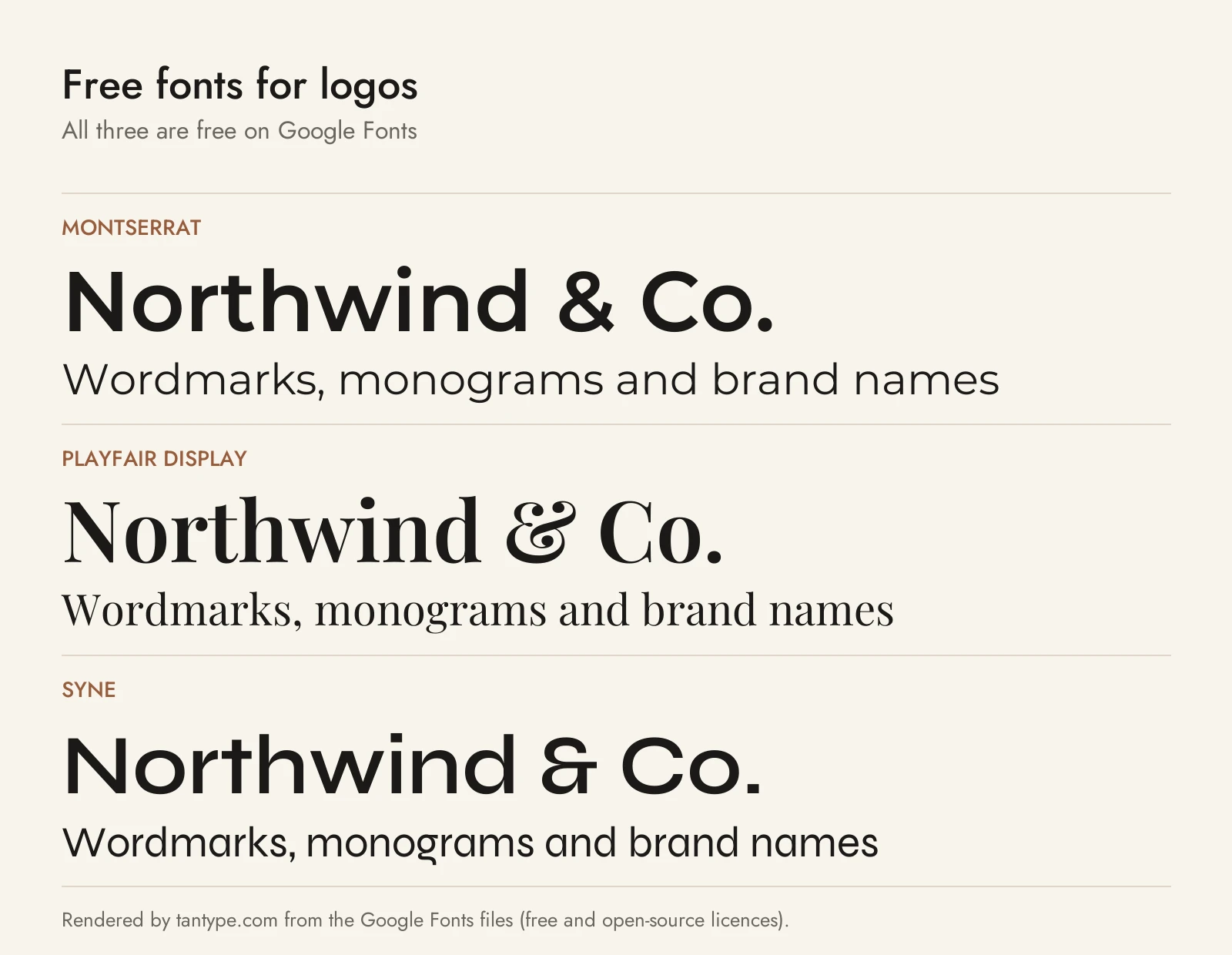
These three are on Google Fonts under the SIL Open Font License, which allows commercial use, logos included. Anyone can use them, so customise the letters or pair them with a strong symbol.
- Montserrat (sans): Julieta Ulanovsky based it on old signs in Buenos Aires’s Montserrat neighbourhood. It is wide and geometric-leaning, variable from Thin to Black with italics and Cyrillic, with a sister family, Montserrat Alternates. It is far more common than Optika or Black Mango.
- Playfair Display (serif): Claus Eggers Sørensen’s high-contrast transitional display serif, influenced by Baskerville and Scotch Roman. It runs Regular to Black with italics, small caps and discretionary ligatures, and is less sharp than Silk Serif or NT Fabulous.
- Syne (display): made in 2017 by Bonjour Monde and Lucas Descroix for Synesthésie, an art centre near Paris, so it began as an identity typeface. It widens as it gets bolder, up to a very broad Extra Bold, but has no italics.
Licensing: personal vs commercial use
Creative Market’s font licence page sets out four licences:
- Desktop: “unlimited commercial and personal projects,” including products, packaging, social media and paid ads; the listings above name logo design as a common use. On sites and apps the font may appear only as images. One seat per user.
- Webfont: embedding on websites you own or control, within a pageview limit.
- App: embedding in one app or game, if the font can’t be extracted.
- E-pub: embedding in one e-book.
Print-on-demand tools where customers set their own text aren’t allowed, and you can’t share the files. None of these fonts has a free personal-use version, and copies from download sites carry no licence. This is a summary, not legal advice.
Logo font FAQ
What are good fonts for logos?
Fonts that stay legible small, have a shape or two that suits your brand, and are licensed for logos. Try Optika or Fander for modern sans logos, Silk Serif or NT Fabulous for luxury, Gistesy or Black Signatures for signatures, and Hudson NY Pro or Tomato Ketchup for bold display.
What are the best logotype fonts?
A logotype, or wordmark, is a logo made only of type; Wikipedia calls it “a text-only statement of the name.” The best logotype fonts let you control individual letters, like Fander’s alternates or Tomato Ketchup’s swashes, or are neutral enough to customise, like Optika.
What are brand fonts?
The typefaces a company uses consistently across its logo, website, packaging and documents, usually a display font and a text font. Google, for example, created Product Sans to accompany its 2015 logo.
Can I trademark a logo made with a Creative Market font?
Creative Market’s licence page says only if the font is modified and isn’t the dominant element, and you must disclaim the font when registering. This is not legal advice.
Can I use a free Google Font in a business logo?
Yes. The OFL FAQ says fonts such as Montserrat, Playfair Display and Syne can be used to create logos. The trade-off is that thousands of other brands use them too.
What font is best for a luxury logo?
Usually a high-contrast serif such as Silk Serif, Montage or NT Fabulous, set in spaced capitals. Test the thin strokes at small sizes first.
