
Kids Fonts: 11 Best Kids Fonts for Children’s Books, Classrooms and Parties
A kids font is a typeface drawn to look friendly to children and parents: round shapes, thick strokes, letters that look written in crayon or marker, and plenty of room inside and between them. You see them on picture book covers, classroom printables, party invitations, toy boxes and nursery prints.
Our top three picks are Kidwriting Pro, a child’s handwriting that still reads comfortably, in five weights; Mallow Soda, a soft bubble font with six solid, outline and shadow styles; and Oranges & Lemons, a marker-drawn caps and script duo. Eight more follow, from crayon and chalk textures to rounded sans serifs.
Browse kids fonts on Creative Market Commercial fonts sold with a licence
Every font in the main list is a commercial font sold on Creative Market. Three free, open-licence Google Fonts are further down, including one built for beginning readers.
What makes a font work for children?
“Kids font” is a mood, not a formal type classification; Creative Market’s kids fonts category calls them “playful and approachable.” A party invitation font only has to look fun; a font a five-year-old must read needs more care.
- Single-storey a and g: children are taught to write the simple forms, not the two-storey a and looped g of most adult fonts. Wikipedia’s entry on the letter A notes the single-storey form is common in handwriting and especially in fonts intended to be read by children. Typographers call these “infant characters”, and Ilene Strizver’s guide to typography for children recommends them for very young readers.
- Letters that can’t be mixed up: b, d, p and q mirror each other, and I, l and 1 can look identical. SIL designed its free font Andika for literacy work, with “clear, easy-to-perceive letterforms that will not be readily confused with one another.”
- A large x-height and open, rounded counters: Strizver writes that larger x-heights are generally easier to read and that counters should be “rounded and open, not angular or rectangular.”
- Generous spacing and size: in a University of Reading study described by Sue Walker in Books for Keeps, many children said very narrow spacing made a text seem more difficult. Strizver suggests 14 to 24 point text, depending on age, and short lines.
The evidence is not one-sided. Walker reports children talking about “reading a’s” and “writing a’s”, yet the two forms “did not affect their reading performance” in the tests. Rosemary Sassoon, a handwriting expert, designed the Sassoon typefaces with Adrian Williams to be particularly legible for children; the family includes Sassoon Primary Infant. Comic Sans, drawn by Vincent Connare in 1994 from comic book lettering, is widely used in schools, and Wikipedia notes its single-storey a and g suit modelling handwriting.
The best kids fonts at a glance
- Kidwriting Pro — readable child’s handwriting in five weights, with dingbats.
- Mallow Soda — soft bubble letters in six solid, outline and shadow styles.
- Oranges & Lemons — marker caps plus a matching script.
- Lazydog Kids — wobbly kid handwriting with 35 dog illustrations.
- Writing Kids — low-contrast childlike hand with ligatures, for $12.
- Jolly Jan — crayon-textured lettering with 25 doodles.
- Kindergarten Krayon — chalkboard-textured capitals for classroom signs.
- Toony Puff — plump cartoon display font.
- Melloby — clean rounded sans for kids’ brands and learning materials.
- Happy Club — chunky rounded capitals for party signs and stickers.
- Little Dinosaur — three cute styles plus 46 dinosaur clipart files.
Best kids fonts on Creative Market
Prices are the regular price for one Desktop seat, checked October 16, 2026; confirm on each listing. None of the listings says whether its a and g are single-storey, so check the previews before setting text for early readers. For fairytale scripts and storybook serifs, see our roundup of the best whimsical fonts; only Lazydog appears in both lists.
1. Kidwriting Pro
Kidwriting Pro, from Manuel Corradine, is the most complete font here. It is a full redraw of his 2007 Kidwriting. The designer describes it as recreating the slightly clumsy look of a child’s handwriting while staying balanced enough for comfortable reading. You get five weights, over 500 glyphs, OpenType old-style figures, ligatures, ordinals and fractions, wide European language support, and 62 dingbats in matching weights. Use it for worksheets, early reader layouts and kids’ menus. Desktop licence: $75.
See Kidwriting Pro on Creative Market
2. Mallow Soda
Mallow Soda, from ZoloDesignHub (designer Petai Jantrapoon), is a “soft, playful bubble-style handwriting font,” in the listing’s words. Letters are rounded and puffy, so short words look friendly on a book cover or a mug. Its strength is range: six styles (Solid, Italic, Outline, Outline Italic, Outline Shadow, Outline Shadow Italic) in OTF, TTF, WOFF, WOFF2 and SVG. Layer Solid under Outline Shadow for a two-colour title. It suits book covers, birthday banners and sublimation T-shirts. Desktop licence: $14.
See Mallow Soda on Creative Market · Read our Mallow Soda review
3. Oranges & Lemons
Oranges & Lemons is a Nicky Laatz duo built on one felt-tip hand: a casual all-caps font and a matching script. Strokes thicken and thin like a real marker, and the caps sit a little unevenly. Both fonts carry OpenType ligatures; switch them on, or repeated letters look identical. The listing covers English and nine other European languages and names children’s books, greeting cards and packaging as uses. Desktop licence: $24.
See Oranges & Lemons on Creative Market · Read our Oranges & Lemons review
4. Lazydog Kids
Lazydog, by JuliyArt (Juliya Kochkanyan), looks like a child wrote it with a fat marker: letters lean and bounce, baselines drift and stroke ends are blunt. A generous x-height and open counters stop it turning into scribble. The package is one OTF font plus 35 dog illustrations and 10 stickers, each in EPS and PNG. It includes Cyrillic, and a later update added Vietnamese, which few kids’ fonts offer. Use it for picture books, comics, baby clothing and birthday invitations. Desktop licence: $21.
See Lazydog Kids on Creative Market · Read our Lazydog review
5. Writing Kids
Writing Kids, from yumnatype (designer Ditya Dewi Anandita), is a casual handwritten font “designed to capture the playful spirit of childhood.” Low contrast between thick and thin strokes keeps lines even, like felt-tip rather than brush. The listing includes upper and lowercase, numerals, punctuation, ligatures and multilingual support, plus PUA encoding, which lets you reach extra characters in apps without OpenType menus. It is the cheapest pick, sensible for captions, labels and one-off printables. Desktop licence: $12.
See Writing Kids on Creative Market
6. Jolly Jan
Jolly Jan, by Becky Simpson, is the crayon pick. The listing calls it “the perfect crayon (or chalk) handwritten font,” with a nostalgic texture and quirky letterforms aimed at kid-related projects. You get one Regular style with upper and lowercase, numbers and punctuation, in OTF, WOFF and WOFF2, plus 25 hand-drawn vector elements in AI and EPS. Use it for scrapbook pages, book covers, greeting cards and kids’ T-shirts. Keep it large so the texture reads. Desktop licence: $15.
See Jolly Jan on Creative Market
7. Kindergarten Krayon
Despite the name, Kindergarten Krayon, from Mint Pixels (designer Ondrej Vasak), imitates chalk on a dusty blackboard rather than crayon. It is a playful all-caps display font with uneven lines and a grainy texture, aimed by its listing at children’s books, school flyers, teacher resources and packaging. With no lowercase, keep it to short headings: a “Reading Corner” sign, a classroom door label, a bulletin board banner. Desktop licence: $15.
See Kindergarten Krayon on Creative Market
8. Toony Puff
Toony Puff, from Gumrega Studio (designer Septi Aji Waluyo), is a “cheerful and plump display font” with rounded, cartoonish letters. It includes upper and lowercase, numbers and punctuation in OTF, TTF and WOFF, and the listing names children’s books, toys, party invitations and educational games as uses. It reads more like a cartoon logo than handwriting. Use it for game titles, toy packaging and party banners. There is one style, so pair it with a lighter font for details. Desktop licence: $15.
See Toony Puff on Creative Market
9. Melloby
Melloby, from Rasio Studio, is the most neutral pick: a rounded sans serif with fully curved stroke ends and thick, even strokes. With no handwritten wobble, it suits kids’ brands that must work on screens too. The listing promises OTF, TTF and WOFF files, numerals, punctuation and a large symbol set, kerning tuned for screens, and support for Canva, Figma and Adobe apps. Use it for children’s brand identities, toy and snack labels, learning materials and YouTube thumbnails. Desktop licence: $24.
See Melloby on Creative Market · Read our Melloby review
10. Happy Club
Happy Club, by Izzy Clarke of Happy Type Club, is a bold, monoline capitals font with rounded ends and wide open counters. It has a stubby, toylike look. There is one style and no lowercase, in OTF and TTF. Spacing is generous and even, which keeps short headlines clear, though tight logos may need manual kerning. Use it for birthday party signs, T-shirts, stickers and greeting card fronts, never for more than a few words. Desktop licence: $16.
See Happy Club on Creative Market · Read our Happy Club review
11. Little Dinosaur
Little Dinosaur, by Angelina Kovel, is a cute hand-drawn font sold with its own illustrations. The download contains three fonts, Regular, Script and Bold, plus 46 clipart elements in PNG, AI and EPS. Use the Script for a child’s name and Regular for details. The listing names books, greeting cards, toys, posters and baby clothing as uses. It makes a matching dinosaur birthday set easy: invitation, banner, toppers, thank-you cards. Desktop licence: $15.
See Little Dinosaur on Creative Market
How to choose a kids font
- Children’s books: playful font for the cover and title page, plain readable font for the story. For early readers, use a font with infant characters, such as Andika.
- Classroom printables: pick a font with both cases, clear numbers and a steady baseline, such as Kidwriting Pro, Writing Kids or Melloby. Keep Kindergarten Krayon and Jolly Jan for headings and door signs.
- Party invitations: one fun font for the child’s name and age, one calm font for date, time and address. Little Dinosaur, Happy Club and Toony Puff suit themed parties.
- Toy packaging and kids’ brands: test the font in the real product name, small and in one colour. Melloby and Mallow Soda stay readable on shelves and screens.
- Nursery decor: soft handwriting such as Oranges & Lemons or Lazydog suits name prints and wall art.
- Cricut and vinyl: solid, chunky letters cut cleanly; crayon and chalk textures and thin outlines do not.
Pair one expressive font with one quiet one.
Free kids fonts
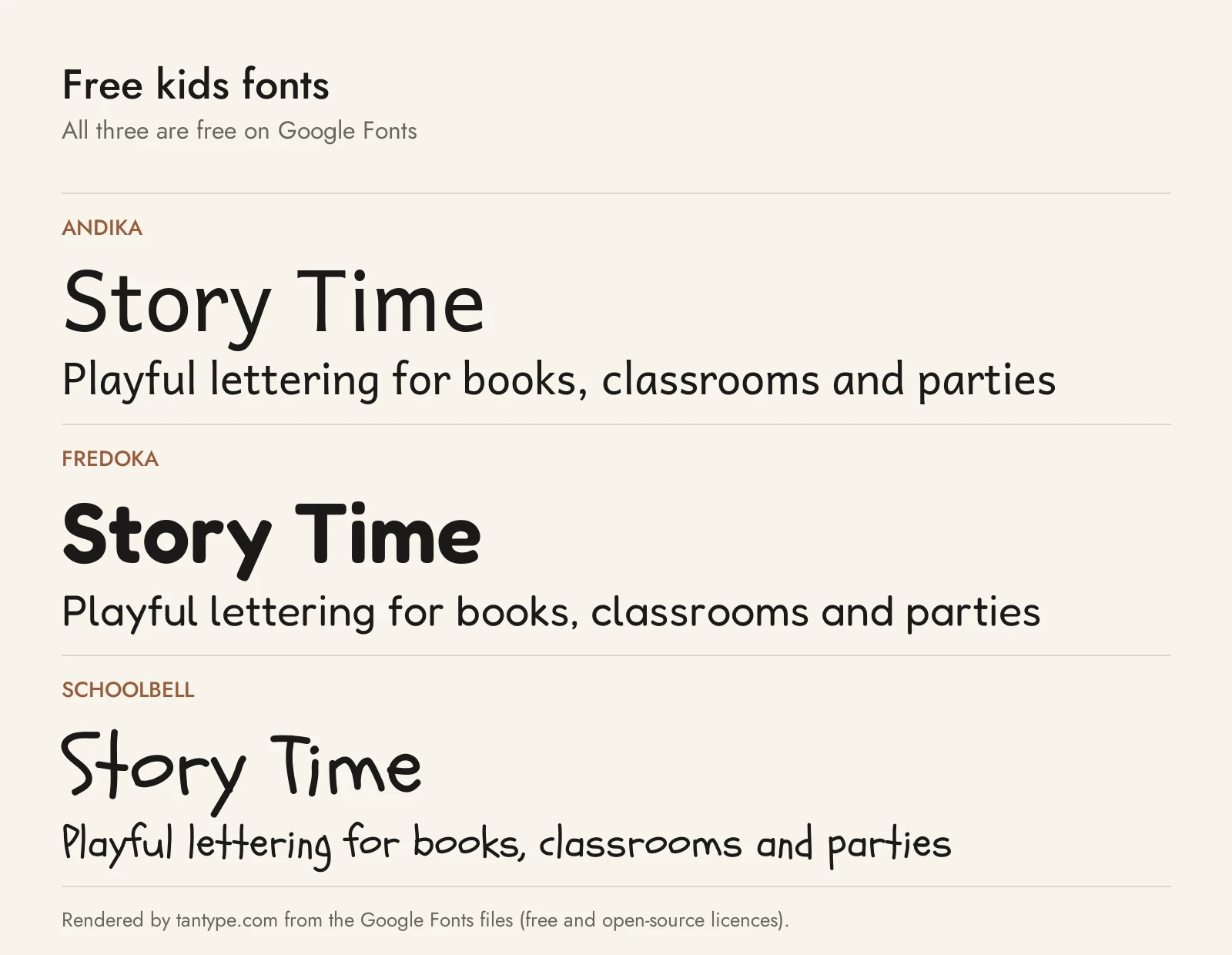
These Google Fonts use open licences, so they are free for commercial work.
- Andika (SIL Open Font License), from SIL International, is the reading font none of the paid picks claims to be. It was designed “especially for literacy use, taking into account the needs of beginning readers”: its a and g are single-storey infant forms, and the capital I has bars to tell it apart from l and 1. It has Regular and Bold with italics and covers Latin, Cyrillic and Vietnamese. Use it for text under playful titles.
- Fredoka (SIL Open Font License), by Milena Brandão with Hebrew by Ben Nathan, is “a big, round, bold font” and a free stand-in for Melloby or Toony Puff. It is variable, with weight (300 to 700) and width axes, and also has a single-storey a and g. It has no outline or shadow styles.
- Schoolbell (Apache License 2.0), by Font Diner, is billed as handwriting from “the finest lettering artist in the 2nd Grade.” It is lighter and more uneven than Lazydog, with one style, basic Latin only and no illustrations.
Licensing: personal vs commercial use
Creative Market sells fonts under four licences, set out on its font licence page:
- Desktop: install the font and use it in “unlimited commercial and personal projects,” including physical end products, packaging, social media and paid ads. Buy one seat per user. On websites and in games the font may appear only in rasterized form, as images; you may not embed the font files.
- Webfont: embed the font in websites you own or control, within the pageview limit chosen at checkout.
- E-pub: embed the font in one e-book title.
- App: embed the font in one app or game.
This matters if you sell what you make. A printed picture book or a toy box falls under the “physical end products” the Desktop licence covers, but the e-book edition needs an E-pub licence and a reading app or educational game needs an App licence. Because Desktop does not allow embedding font files, clear editable templates or PDFs with embedded fonts with the seller first; flattened images are safer. Print-on-demand tools where customers type their own text are not allowed, since “only the Licensee may use the font to create a completed end product.” Sellers can add terms, so read each listing. This is a summary, not legal advice.
Kids font FAQ
What is the best font for kids to read?
Look for single-storey a and g, a large x-height, open round counters and generous spacing. Andika is free and made for beginning readers; Sassoon Primary is a paid font built for schools.
What font do children’s books use?
Covers use playful display or hand-lettered fonts; the story needs something readable. In Walker’s study, children called Century, Gill and Fabula “normal”, and some liked the “normal” g of Gill Schoolbook.
What is a good classroom font for teachers?
For worksheets, use a font with both cases, clear numbers and ideally infant characters: Andika or Comic Neue for free, Kidwriting Pro or Writing Kids from Creative Market.
Are there free kids fonts for commercial use?
Yes. Andika, Fredoka and Schoolbell on Google Fonts are free for commercial use, and Baloo 2, Sniglet, Comic Neue and Short Stack are other playful choices there. “Personal use only” downloads elsewhere do not cover sales.
Can I use a kids font on products I sell?
With Creative Market’s Desktop licence you can sell physical products made with the font, such as printed books, T-shirts and packaging. E-books need an E-pub licence, apps and games an App licence, and customer-personalised print-on-demand products are not allowed.
