
Cursive Fonts: 10 Best Cursive Fonts, from Elegant Script to Everyday Handwriting
Cursive fonts copy joined-up handwriting: the letters link in one flowing line, the way many of us learned to write at school. They range from formal wedding scripts to loose everyday notes, but in a real cursive font the lowercase letters connect.
Our top three picks are Little Promises, a dip-pen cursive with three to five versions of every letter; Ecatherina, a formal copperplate-style script in 15 styles; and VS Grandma’s Recipe, based on the designer’s grandmother’s handwriting. All ten picks are commercial fonts sold on Creative Market; three free cursive fonts from Google Fonts are further down.
Browse cursive fonts on Creative Market Commercial fonts: prices below are regular one-seat Desktop prices, checked October 16, 2026
What is a cursive font?
Wikipedia defines cursive as “any style of penmanship in which characters are written joined in a flowing manner”, usually to write faster than with block letters. The word goes back to the Medieval Latin cursivus, which “literally means ‘running'”. A cursive font turns that joined hand into type.
In looped cursive, ascenders and descenders loop so the letters can link; italic cursive uses joins without loops and doesn’t join every letter. Wikipedia also notes that “formal cursive is generally joined, while casual cursive combines joins with pen lifts”. The same holds for fonts: formal cursives join almost everything, casual ones leave small gaps like a real hand.
From Spencerian to school cursive
In the United States, cursive was taught through a few systems. Spencerian script was the standard business hand from about 1850 to 1925. The Palmer Method, developed by Austin Palmer around 1888, became “the most popular handwriting system in the United States”. From the 1950s it gave way to Zaner-Bloser, which teaches print before cursive, and to D’Nealian, introduced in 1978 to ease the step from print to cursive. The Common Core standards “do not include instruction in cursive”, though California passed cursive legislation in 2023.
Cursive vs script, calligraphy and handwriting fonts
- Script fonts are the wider family. Wikipedia’s script typeface article says they “are based on the varied and often fluid strokes created by handwriting”, and splits them into formal scripts, which resemble cursive writing, and casual scripts, which look brush-made. Some scripts don’t join, so every cursive font is a script but not every script is cursive.
- Calligraphy fonts imitate calligraphy, “fine handwriting as a visual art”, made with a pen or brush that gives thick and thin strokes. Many are cursive, but the focus is stroke contrast rather than joins. See our calligraphy fonts roundup.
- Handwriting fonts imitate everyday writing with a pen or pencil. They can be printed (unjoined) or cursive. Belmonte Ballpoint, below, includes one of each.
- Brush scripts are written with a brush or brush pen and are usually bolder and rougher; see our brush script fonts guide.
The best cursive fonts at a glance
- Little Promises: realistic dip-pen cursive.
- Ecatherina: formal copperplate-style script in 15 fonts.
- VS Grandma’s Recipe: imperfect, old-fashioned real handwriting.
- Maison Sezanne: slim, elegant cursive for invitations.
- Nostalgia: dark, inky vintage cursive with swash endings.
- Dear Amora: soft, love-letter cursive.
- Marilyn Wilde: neat, friendly everyday cursive.
- Bowline Script: classic monoline cursive with a vintage style.
- School Cursive: US classroom cursive with lined, dotted and arrow styles.
- Belmonte Ballpoint: ballpoint handwriting in cursive and print.
Best cursive fonts on Creative Market
Prices are regular one-seat Desktop licences as listed on October 16, 2026; check the listing before you buy.
1. Little Promises: dip-pen cursive that looks really written
Sam Parrett calls Little Promises “an elegant cursive handwriting font”, written on paper with a glass dip pen and ink. The letters join in a natural, slightly uneven line. There are more than 500 glyphs, with three to five variations of every letter: with Standard Ligatures on, type a number after a letter (“t1”) to get an alternate, and double-letter ligatures switch in automatically. It is PUA encoded, so extras can be pasted into apps such as Canva, and covers 23 Latin-script languages. Use it for letters, invitations and quotes. Desktop licence: $22.
See Little Promises on Creative Market · Read our Little Promises review
2. Ecatherina: formal cursive with Word and Cricut help
Ecatherina, from Dmitrii Mikitenko of Blessed Print, is the most formal pick: a copperplate-style script with fine hairlines and huge looping capitals. It comes as 15 fonts, five weights from Thin to UltraBold in three hairline thicknesses, so thin strokes can be made heavier where they would break up. The listing counts 1,436 glyphs; capitals have three or more alternates, reached by typing a number after a letter or through PUA codes. The download includes an example .docx for Microsoft Word and Figma invitation templates, and the designer says it works with Silhouette and Cricut. Desktop licence: $39.
See Ecatherina on Creative Market · Read our Ecatherina review
3. VS Grandma’s Recipe: real, imperfect handwriting
Vicarel Studios describes VS Grandma’s Recipe as a “realistic handwritten script font” based on the designer’s grandmother’s handwriting. It looks like old-fashioned looped cursive written quickly: angles, weight, spacing and baseline all wander a little. It offers two or three versions of every letter, number and punctuation mark, 155 glyphs, alternates and ligatures in all; turn on Standard Ligatures to use them. Files come as OTF, WOFF and WOFF2. It suits recipe cards, cookbooks, labels and anything that should look family-made. Desktop licence: $19.
See VS Grandma’s Recipe on Creative Market · Read our Grandma’s Recipe review
4. Maison Sezanne: slim cursive for invitations
Oksana Petrenko of Calamar Studio says Maison Sezanne is “inspired by refined calligraphy and timeless European aesthetics”. On the previews it is a slim, sloping cursive with a fine pen line, joined lowercase and capitals that loop back on themselves. It looks formal without heavy flourishes, so names stay readable. The designer suggests it for wedding stationery, menus, editorial and beauty branding, paired with a clean serif or sans. The listing includes TTF, OTF and WOFF files but doesn’t give glyph or alternate counts. Desktop licence: $19.
See Maison Sezanne on Creative Market · Read our Maison Sezanne review
5. Nostalgia: dark, inky vintage cursive
PeachCreme describes Nostalgia as writing that is “dark, inky, old-fashioned, and quaint”, inspired by inky handwriting. The cover shows a fast, steeply slanted cursive with long ascenders and a swash running off the final letter. The listing says it is “very simple to read” and highlights its starting and ending lowercase swashes. It comes as OTF, TTF, WOFF and WOFF2. Use it for vintage-style wedding stationery, social media quotes and packaging. Desktop licence: $19.
See Nostalgia on Creative Market · Read our Nostalgia review
6. Dear Amora: love-letter cursive
Perplexitics pitches Dear Amora as “a handwritten font that feels like a love letter left between the pages of an old journal”. It is a light, nearly monoline cursive with big looped capitals and lowercase that joins in a relaxed, slightly bouncing line. There is one style, Dear Amora Regular, in OTF and TTF, with alternates, ligatures and a long list of accented Latin characters. It is gentle rather than showy: use it for short poems, wedding details and stationery headings. Desktop licence: $17.
See Dear Amora on Creative Market · Read our Dear Amora review
7. Marilyn Wilde: neat everyday cursive
Mila Garret says Marilyn Wilde was inspired by neat cursive handwriting. Strokes are thin and even, letters join cleanly and the slant is gentle, which makes it one of the easiest picks to read small. The package has 83 ligatures, extra stylistic alternates, multilingual characters and a rough version for a more inky look. It is PUA encoded. Use it for signature logos, photography watermarks, labels and Instagram quotes. Desktop licence: $17.
See Marilyn Wilde on Creative Market · Read our Marilyn Wilde review
8. Bowline Script: classic monoline cursive
Andrew Footit calls Bowline “a classic monoline cursive script font”. Every stroke has the same width, like a felt pen, and the letters join in a rounded, slanted hand with a retro feel. The family has three fonts: two weights and a textured Vintage version. Stylistic alternates are offered for b, d, f, g, h, k, m, n, p and y, plus swashes as separate glyphs. Use it for packaging, posters, book covers and retro branding. Desktop licence: $23.
See Bowline Script on Creative Market
9. School Cursive: the alphabet you learned in class
School Cursive, from Cursive Workshop, is built for teaching rather than branding. The listing says it “mimics the style found in common US curricula since the 1970s”, with fully connected lowercase whose joins stay close to the midline. Fontspring, which sells the same family, describes a base font plus lined versions with baseline, midline and headline, dotted versions for tracing and versions with arrows that show stroke order. It is the pick for worksheets and name tracing, and by far the dearest. Desktop licence: $120.
See School Cursive on Creative Market
10. Belmonte Ballpoint: cursive and print from a biro
Laura Eddy’s Belmonte Ballpoint, sold by TYPEHEIST, imitates a ballpoint pen, texture and wobble included. It has two matching styles, print and cursive, so you can mix joined and unjoined writing as people really do. The cursive is casual: most letters join, some break, as in a quick note. The package lists 1,034 glyphs, 197 custom ligatures, extra stylistic sets for A–Z and 0–9, 25 scribble glyphs and extended Latin, in OTF, WOFF and WOFF2. Use it for journals, notes, social graphics and packaging. Desktop licence: $24.
See Belmonte Ballpoint on Creative Market · Read our Belmonte Ballpoint review
How to choose a cursive font
- Decide how formal it should be. Shaded, looping scripts (Ecatherina, Maison Sezanne) say wedding and luxury; monoline cursives (Bowline, Marilyn Wilde) feel friendly; imperfect hands (Grandma’s Recipe, Belmonte) feel personal. For signature-style and tattoo lettering, see our cursive tattoo fonts roundup.
- Check readability at your real size. Cursive is harder to read than print, and loops close up when small. Test your longest word at actual size, keep body text in a plain font, and never set cursive in all caps.
- Keep the joins intact. Connected letters are drawn to meet at a set spacing. Adding letter spacing (tracking) pulls them apart, so leave it at zero.
- Turn on ligatures and alternates. Much of the handwritten look lives in OpenType features. Microsoft’s Word help explains that the Advanced tab of the Font dialog controls ligatures, stylistic sets and “Use Contextual Alternates”, which “automatically uses alternate characters only in special situations” and is especially useful for script fonts. Choose a ligature setting other than None, and tick contextual alternates.
- Canva. Canva’s upload fonts help page says Pro, Teams and similar plans can add OTF, TTF or WOFF files to a Brand Kit, and that fonts should be licensed for embedding. For alternates, the Little Promises listing says to paste PUA-encoded characters into Canva from Font Book (Mac) or Character Map (Windows), so PUA encoding (also in Marilyn Wilde and Ecatherina) helps.
- Cricut. Design Space can use fonts installed on your computer. Cricut’s own guide, Working with fonts in Cricut Design Space, shows lowering the letter spacing so the letters overlap and then using Weld so the word cuts as one piece. It warns that intricate system fonts can be hard to cut and recommends smooth edges and an even weight, so avoid hairline scripts for vinyl. For pen drawing, it suggests a Cricut writing-style font.
Free cursive fonts
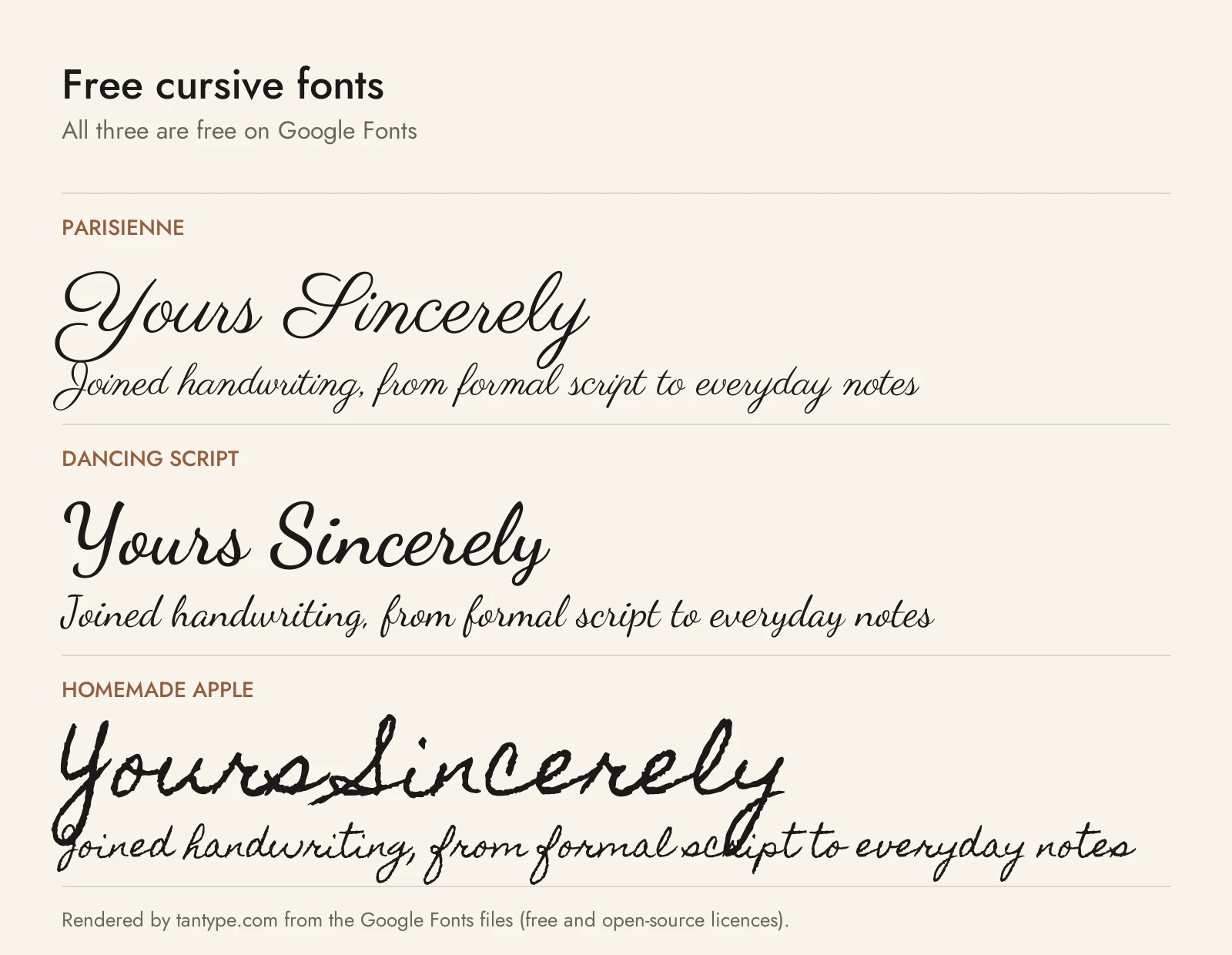
All three are on Google Fonts, under the SIL Open Font License (Parisienne, Dancing Script) or Apache License (Homemade Apple), which allow commercial use.
- Parisienne: Astigmatic’s “casual connecting script”, inspired by a 1960s advertisement, with a slight bounce. It is the closest free match to Maison Sezanne, but has one style and no alternates.
- Dancing Script: Impallari Type’s “lively casual script where the letters bounce and change size slightly”, based on 1950s scripts. It is bolder and rounder than any paid pick, comes in weights from 400 to 700, and holds up better on screens and signs.
- Homemade Apple: Font Diner’s “cursive handwriting script”, the free option nearest to Grandma’s Recipe and Belmonte Ballpoint. It looks like quick pen writing, but without their alternates, repeated letters look identical.
Licensing: personal vs commercial use
Creative Market sells fonts under four licences, set out on its font licensing page:
- Desktop: use the font in “unlimited commercial and personal projects”, including products you sell. Buy one seat per user.
- Webfont: embed the font in websites you own or control, up to the pageview limit chosen at checkout.
- E-pub: embed the font in one e-book or digital publication.
- App: embed the font in one app or game.
Print-on-demand use “is forbidden whenever the end user is not the Licensee”, which rules out shops where customers type their own text in the font. For logos, Creative Market says a font can be part of a logo if it is modified and isn’t the dominant element, and you must disclaim the font when registering a trademark. If a cursive wordmark is the whole logo, ask the designer first. This is a summary of published terms, not legal advice.
Cursive font FAQ
What is the best cursive font?
For realistic joined handwriting, Little Promises. For formal invitations, Ecatherina or Maison Sezanne. For casual, homemade writing, VS Grandma’s Recipe. For worksheets and teaching, School Cursive. The best free cursive font for elegant work is Parisienne.
What is a cursive letters font?
A font in which the lowercase letters are drawn to join, so typed words look written in one stroke. If you want the letter shapes taught in American schools, look for a classroom font such as School Cursive rather than a decorative script.
Which cursive font looks most like real handwriting?
The ones with many alternates per letter: Little Promises (three to five per letter), VS Grandma’s Recipe (two or three) and Belmonte Ballpoint. Alternates stop doubled letters such as “ll” or “ee” from looking copied and pasted.
Are there free cursive fonts for commercial use?
Yes. Parisienne, Dancing Script and Homemade Apple on Google Fonts allow commercial use. Free downloads of paid fonts from other sites come with no valid licence.
