Brush Script Fonts: 10 Best Brush Script Fonts for Logos, Labels and Lettering
A brush script font copies letters written with a loaded brush or a brush pen: joined or loosely joined strokes that swell where the writer pressed and thin out where the brush lifted. The name also belongs to one specific typeface, Brush Script, drawn in 1942 and bundled today with Microsoft Office and macOS as Brush Script MT.
Our top three picks are Midnight Symphony, a dry-brush script with 115 alternate lowercase letters; Haglos, a heavy retro brush script with Extrude styles; and Amber Dawn, painted with acrylic ink and split into three fonts so letters don’t repeat. Every font on the main list is a commercial font sold on Creative Market. Three free Google Fonts options are further down.
Browse brush fonts on Creative Market Commercial fonts: prices below were checked on October 16, 2026
What is a brush script font?
The phrase has two meanings.
Brush Script, the typeface. Brush Script was designed by Robert E. Smith for American Type Founders (ATF) in 1942. Fonts In Use notes that ATF released it simply as “Brush.” It was cast in metal, and Microsoft’s font notes point out that in 1942 “making a script typeface that seemed to join seamlessly was a daunting technical undertaking.” Wikipedia says its joined lowercase is “deliberately irregular” to look handwritten, and that it was an almost immediate hit with advertisers. It stayed popular through the 1950s and faded in the 1960s as the International Typographic Style took hold.
The version most people know is Brush Script MT, Monotype’s digital cut. Microsoft’s typography page lists it as a single style, Brush Script MT Italic (copyright 1993), “available within Office applications.” Apple’s macOS Sequoia font list includes Brush Script MT Italic too, and Adobe Fonts carries an Adobe Originals version of Brush Script. Fonts In Use counts many digitisations “of mixed quality,” plus ATF Brush (2015), which adds four new weights. Ubiquity has cost it: it placed third among “least favorite” fonts in a 2007 designers’ survey, and Simon Garfield’s Just My Type ranked it fifth of the eight worst fonts.
Brush script, the style. Brush Script is one of the casual scripts. Wikipedia’s script typeface article says their strokes “often appear to have been created by wet brush rather than a pen nib,” and that advertisers used them into the 1970s; Kaufmann and Mistral are other examples. Today the style splits into three rough families:
- Dry brush: the bristles run short of ink, so strokes break up and show streaks, especially on long connectors.
- Brush pen: smoother edges and strong thick-thin contrast from a felt or nylon tip, closer to modern hand lettering.
- Painterly: real acrylic or ink strokes, scanned and kept rough, sometimes stored as OpenType-SVG colour fonts so the texture survives at full detail.
The best brush script fonts at a glance
- Midnight Symphony — dry-brush texture with 115 lowercase alternates.
- Haglos — heavy retro brush script in three weights, each with an Extrude style.
- Amber Dawn — acrylic-painted, three fonts of letters and 29 ligatures.
- Northwell — rustic dry strokes with a clean version for cutting machines.
- Feeling Passionate — tidy brush script with 52 swashes.
- Breathing — brush signature script with 52 stylistic sets.
- Authenia Textured — fast brush-pen script with two lowercase sets.
- Glory Culture SVG — painted texture built into a colour font.
- Paloma — loose artist-signature brush lettering.
- Picasso’s Paintbrush — the messiest pick, a splashy ink script duo.
Best brush script fonts on Creative Market
Prices are for a one-seat desktop licence as listed on Creative Market on October 16, 2026; prices and sales change, so check the listing.
1. Midnight Symphony
PeachCreme describes Midnight Symphony as a hand-drawn brush script that “keeps its original dry-brush texture.” The breaks in the middle of strokes are intentional: they show where the ink faded and caught again. The depth is in the alternates: 115 lowercase and 43 capital alternates across seven stylistic sets, plus 15 double-letter ligatures such as bb, ll and tt. Use it for book covers and rustic labels. Desktop licence: $19.
See Midnight Symphony on Creative Market · Read our Midnight Symphony review
2. Haglos
Haglos, from Vultype Co., is the pick closest in spirit to the original Brush Script: a heavy, slanted, joined brush letter with a mid-century advertising feel. The designer cites “modern vintage & retro style” combined with “old american traditional style.” It now comes in Regular, SemiBold and Bold, and each has an Extrude version, six files in all. You also get bonus swashes, stylistic sets, ligatures, PUA encoding and multilingual characters. Some buyer reviews mention install problems, so read them first. Good for logos, sports and diner branding, and merchandise. Desktop licence: $25.
See Haglos on Creative Market · Read our Haglos review
3. Amber Dawn
Sam Parrett painted Amber Dawn “with a real paintbrush and acrylic ink” and kept the erratic strokes and texture. You get three separate fonts, each with its own upper and lowercase set, plus 29 ligatures and two sets of numerals: 482 glyphs in total. Language support covers 23 languages, and PUA encoding lets you paste letters into Canva from Font Book or Character Map. It suits playful logos, retro-revival posters and packaging. Desktop licence: $21.
See Amber Dawn on Creative Market · Read our Amber Dawn review
4. Northwell
Northwell is one of Sam Parrett’s best-known fonts, a rustic handwritten script with quick, dry strokes. It comes in a textured version and a clean, smooth-edged version, which the listing recommends for Cricut and Silhouette cutting. The package holds six TTF files: Northwell, Northwell Alt (a second set of letters), Northwell Swash (20 swashes), and clean versions of all three. Double-letter ligatures work in OpenType apps. Use it for homeware, labels and text over photos. Desktop licence: $18.
See Northwell on Creative Market · Read our Northwell review
5. Feeling Passionate
Din Studio calls Feeling Passionate “a casual and beautiful brush font.” Next to the textured picks it looks clean: smooth brush strokes, loops that stay clear of the next line and a steady slant, so it holds up over a short sentence. The package is generous for the price: 78 alternates, 15 ligatures and 52 swashes, with PUA encoding so you can reach them without a glyphs panel. One reviewer, a teacher, says it sits “just between manuscript and cursive.” Good for quotes, social graphics and book covers. Desktop licence: $34.
See Feeling Passionate on Creative Market · Read our Feeling Passionate review
6. Breathing
Breathing, also from Din Studio, is a brush signature font: fast and slanted, like a name written with a felt-tip brush. Strokes swell and taper with pressure, and the baseline rises and falls from letter to letter. That style needs variety, and Breathing has it, with 52 stylistic sets and 37 ligatures, plus PUA encoding, numerals, punctuation and multilingual support. Signature scripts read best on a word or two. Use it for personal brands, photographer watermarks, beauty packaging and social media. Desktop licence: $34.
See Breathing on Creative Market · Read our Breathing review
7. Authenia Textured
Mika Melvas wrote Authenia quickly with a brush pen on paper, then scanned it and redrew it as vectors. The Textured version keeps the dry brush-pen grain; a cleaner Authenia Solid is sold as a separate listing. Its best feature is two sets of lowercase letters: turn on Contextual Alternates and the font swaps between them at random, which breaks up repeated letters in longer text. There are also stylistic alternates and underline swashes. It works for rustic branding, craft products and handwritten quotes. Desktop licence: $29.
See Authenia Textured on Creative Market · Read our Authenia Textured review
8. Glory Culture SVG
Glory Culture is a modern brush script whose painted strokes are stored inside the font as a transparent texture, using the OpenType-SVG colour format. The package has four SVG fonts (Glory Culture, an Alt version with new upper and lowercase, an All Caps font and a Swash font with 18 swashes) plus TTF versions of all four with solid fills. The script fonts have 27 ligatures. The SVG files need Photoshop CC 2017, Illustrator CC 2018 or Procreate 4.3 or newer; accents for 23 languages are in the TTF version only. Best for social posts, adverts and product labels. Desktop licence: $24.
See Glory Culture on Creative Market · Read our Glory Culture review
9. Paloma
Madeline O’Donoghue based Paloma on artist signatures, brush lettering and sketchbook marks, and built it from real painted letterforms with loose strokes and irregular edges. It looks like a name signed with a nearly dry brush. The kit is minimal: one OTF file with A–Z, a–z, 0–9 and basic punctuation, and no alternates or accents. The listing says it works best at small to medium display sizes, because very large uses exaggerate the texture. Pick it for artist branding, menus and invitations. Desktop licence: $19.
See Paloma on Creative Market · Read our Paloma review
10. Picasso’s Paintbrush
Nicky Laatz calls this duo “Unapologetically Messy.” The script is full of splashes, scratches and loose loops meant to look like unruly ink on paper, with wobbly edges and uneven stroke width. A calmer companion style keeps layouts readable when the script gets loud. The script includes OpenType ligatures and capital alternates, and PUA encoding makes them usable in Canva. It is the wildest pick here: use it for record sleeves, fashion and avant-garde invitations. Desktop licence: $22.
See Picasso’s Paintbrush on Creative Market · Read our Picasso’s Paintbrush review
How to choose a brush script font
- Pick the texture first. For a mid-century, Brush Script MT feel, choose a heavy, smooth letter such as Haglos. For a handmade or rustic look, choose dry brush (Midnight Symphony, Northwell, Authenia Textured). For an art-school or street feel, choose painterly fonts (Amber Dawn, Glory Culture, Paloma, Picasso’s Paintbrush).
- Check the alternates. Repeated identical letters give the game away. Midnight Symphony, Feeling Passionate, Breathing and Amber Dawn have the deepest sets.
- Know your software. Alternates and ligatures need OpenType support. In Canva or Word, choose a PUA-encoded font such as Amber Dawn, Haglos or Picasso’s Paintbrush and paste glyphs from Font Book or Character Map.
- Colour fonts have limits. OpenType-SVG versions (Glory Culture) need recent Adobe apps or Procreate. Use the included TTF files everywhere else.
- Cricut, vinyl and embroidery need clean outlines. Use smooth versions like Northwell Clean; textured edges create hundreds of tiny cut points and fill in when stitched.
- Keep it short. Set a word or a line, pair it with a plain sans or serif, and avoid all capitals unless the font has a caps set.
Free brush script fonts
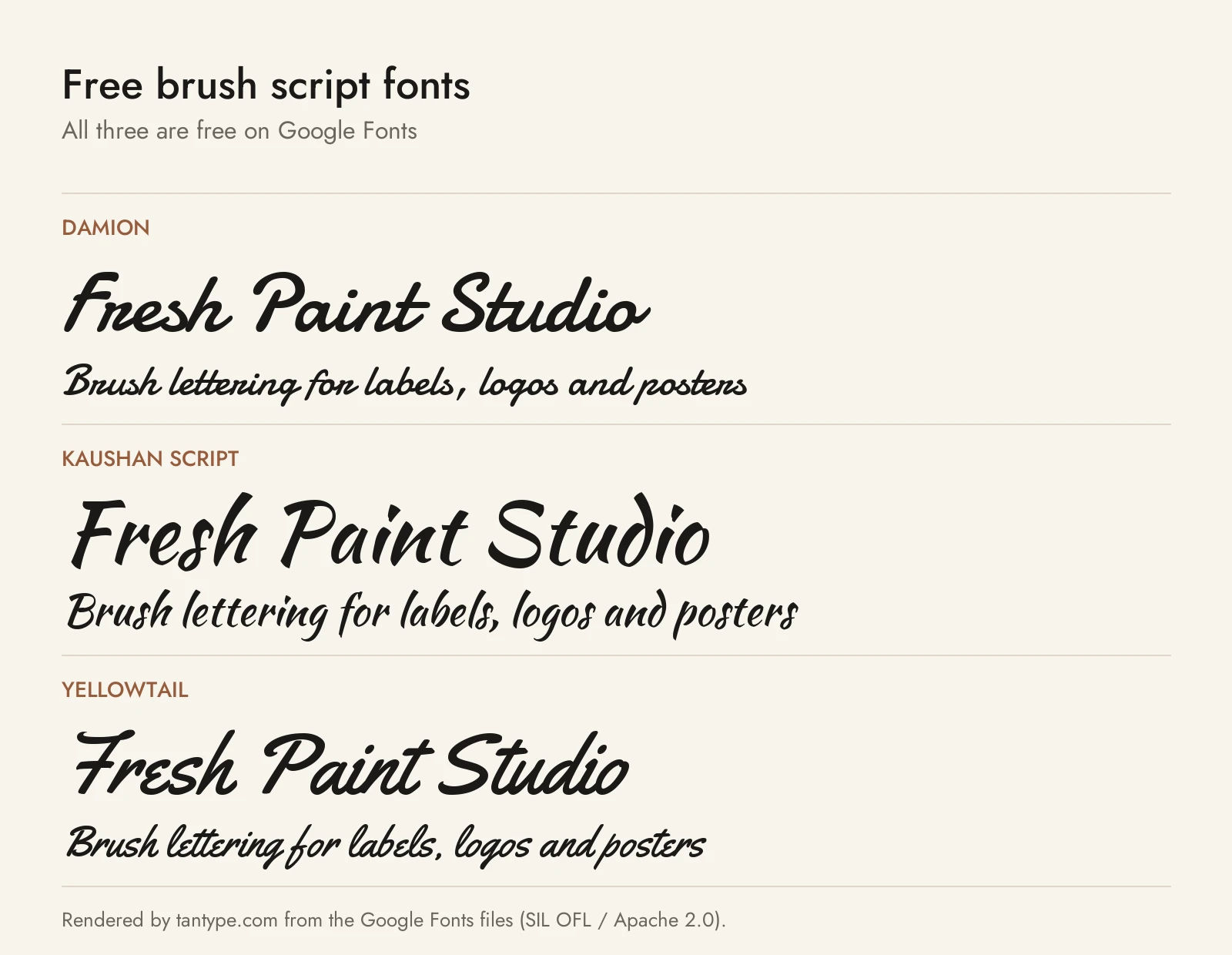
These three are free on Google Fonts for personal and commercial use. Each has one style, with no alternates or swashes.
- Damion by Vernon Adams (SIL Open Font License) is the closest free relative of Brush Script. Google Fonts describes it as a casual script “derived from some typical mid C20 casual typefaces such as that drawn by Max Kaufmann in 1936 for American Type Founders.” It is smooth and joined, like Haglos, with no texture.
- Kaushan Script by Impallari Type (SIL Open Font License) was funded through a Kickstarter project for a fast brush script. Its designer left it “unrefined” on purpose: the vertical strokes vary in angle and the baseline jumps around. It also has short ascenders and descenders, so it stays readable as small as 16 px on the web.
- Yellowtail by Astigmatic (Apache License 2.0) is “an old school flavored flat brush script” that nods to 1930s faces such as Gillies Gothic and Kaufmann. It mixes connecting and non-connecting letters, so it reads more like sign lettering than Damion.
Licensing: personal vs commercial use
Creative Market sells fonts under four licences, explained on its font licence page:
- Desktop: the font can appear in “unlimited commercial and personal projects,” including print, merchandise, logos and social media. On websites, apps and games it may only appear as images, and in design or print-on-demand tools only when you create the finished product yourself.
- Webfont: embedding on websites you own or control, up to a pageview limit.
- App: embedding in one app or game, as long as the font can’t be extracted.
- E-pub: embedding in one e-book or electronic publication.
Prices vary widely between licences. Feeling Passionate, for example, listed $34 for Desktop but $699 for App on October 16, 2026, so check the licence list before you build a site or app around a font. Tattoos aren’t mentioned on the licence page, so ask the designer. Copies from free download sites carry no licence. Brush Script MT is a separate case: it comes under the licence of Microsoft Office or macOS, and Microsoft’s page sends businesses that need redistribution or server rights to Monotype. This is a summary, not legal advice; check each listing’s terms.
Brush script font FAQ
What is the Brush Script font?
Brush Script is a connecting casual script designed by Robert E. Smith for American Type Founders in 1942. Its digital version comes with Microsoft Office and macOS and appears in font menus as Brush Script MT Italic.
Is Brush Script free to use?
Brush Script MT comes with Office and macOS, but it isn’t open source or on Google Fonts. For use beyond your own documents, read Microsoft’s font redistribution FAQ. To license it separately, Monotype sells Brush Script on MyFonts, listed from $29.99 per style on October 16, 2026. For a free alternative with a similar feel, try Damion.
What is a brush script handwriting font?
It is a handwriting font written with a brush or brush pen instead of a ballpoint or nib, so the letters keep a brush’s thick-thin contrast and usually join like cursive. Authenia Textured, for example, was written with a brush pen on paper, then scanned and redrawn as vectors.
What is the difference between a brush font and a brush script font?
“Brush font” covers anything that looks painted, including all-caps brush lettering, graffiti and paint-texture display faces. A brush script font is the joined, handwriting-like branch of that group. Every brush script is a brush font, but not every brush font is a script.
Why do designers dislike Brush Script?
Mostly overuse. Because it came with so many computers, it turned up on countless flyers and shop signs. A newer brush script with alternates looks less familiar and more hand-made.
