
Medieval Fonts: 12 Best Medieval Fonts for Fantasy, Celtic and Manuscript Designs
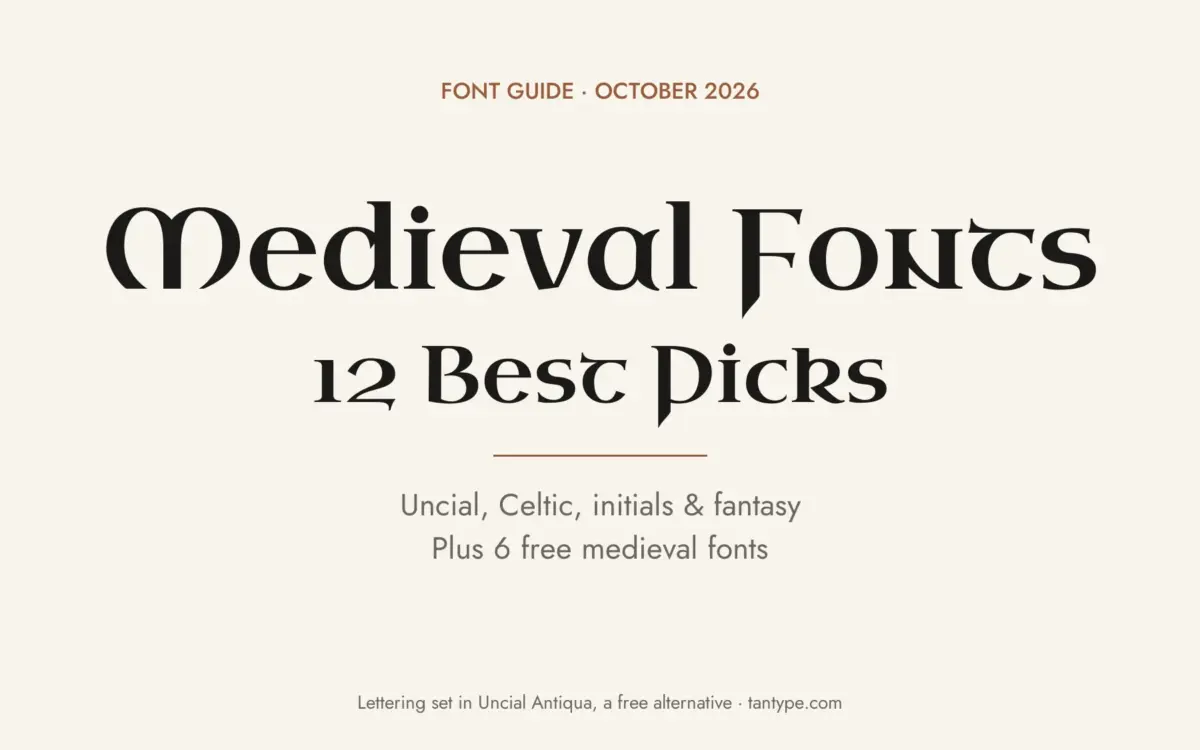
The right medieval font depends on which Middle Ages you mean: the round uncials of Irish monks, the clear Carolingian book hand of Charlemagne’s scribes, the painted capitals that open a chapter, or the carved lettering of a modern fantasy game. This guide covers all of them, not only blackletter.
If you only try three, start with CS Ravella for Celtic and uncial lettering, 825 Karolus for an authentic manuscript text hand and Arcane Fable for fantasy book covers. All twelve picks are commercial fonts sold on Creative Market, so they need a licence. Six free fonts that allow commercial use are further down.
See medieval fonts on Creative Market Commercial fonts; one-seat desktop licences for these picks are $12 to $25 at regular price (October 2026)
What is a medieval font?
A medieval font is a typeface that imitates lettering from the European Middle Ages, roughly 500 to 1500: round uncials and Celtic insular hands, the clear Carolingian minuscule, angular Gothic blackletter and painted Lombardic initials. Modern fantasy and game lettering built on those shapes counts too. Medieval scribes wrote by hand; the fonts came later.
Uncial and half-uncial: the round book hands
Uncial is a script written entirely in capitals, used by Latin and Greek scribes from the 4th to the 8th century, according to Wikipedia’s uncial script article. Its letters are broad and rounded. Half-uncial, a related hand, added ascenders and descenders that point toward lowercase. An uncial font is the classic choice for anything early medieval, monastic or Celtic.
Insular and Celtic hands: the Book of Kells look
The Celtic font look comes from insular script, which developed in Ireland in the 7th century and spread to Anglo-Saxon England and to Irish monasteries on the continent. Trinity College Dublin, which owns the Book of Kells, says it was written close to the year 800 “in a bold and expert version of the script known as ‘insular majuscule'”, with plant, animal and human ornament running through the text. The Lindisfarne Gospels (around 715–720, now in the British Library) use the same family of script. Irish kept insular-derived letterforms in print until the 1950s, one reason uncial and insular fonts still read as “Irish” today.
Carolingian minuscule: the medieval script you already read
Under Charlemagne, with Alcuin of York running the palace school, scribes in the late 8th century standardised a clear, rounded lowercase with few ligatures and regular word spacing. Wikipedia’s Carolingian minuscule article explains that it spread across Europe and later hardened into Gothic. Renaissance humanists copied it again in the early 1400s, believing it was ancient Roman, and their humanist minuscule became the model for roman type. A Carolingian font is the most legible medieval option.
Gothic blackletter: the look most people picture
From the late 12th century, book hands grew taller, narrower and more angular. Blackletter stayed in use across Western Europe until the 17th century and became the type of Gutenberg’s Bible. Our best blackletter fonts guide covers textura, rotunda, Schwabacher and Fraktur, so this roundup keeps Gothic to a minimum.
Lombardic capitals and illuminated letters
Lombardic capitals are rounded decorative capitals with thick, curved stems, used in inscriptions and at the start of sections in manuscripts and early printed books. Scribes often alternated red and blue ones to mark successive paragraphs. A historiated initial goes further and holds a painted scene. Choir books, says the Getty Museum, “often featured oversized illuminated initials”, and one 15th-century Sienese initial in its collection shows the archangel Michael standing on a dragon. Today they survive as drop cap and initials fonts.
Renaissance lettering: humanist hands and Roman capitals
Renaissance scribes paired humanist minuscule with capitals copied from Roman inscriptions. That pairing, plus the quill-written italic, gives the “Renaissance font” look: calligraphic, lighter than Gothic, and easier to read. For the inscriptional capitals see our Trajan Pro article; for pen-made lettering see our best calligraphy fonts.
Fantasy fonts and game lettering
Much of what people now call a fantasy font is a 20th-century invention. Victor Hammer’s uncial typefaces, starting with one released by Klingspor in 1923 and including American Uncial in 1943 (Wikipedia), turned the old book hand into type. Fonts In Use records that the title of Ralph Bakshi’s 1978 Lord of the Rings posters was lettered loosely after Hammer-Unziale, with Tolkien’s name in American Uncial. Renaissance fairs, which began with a weekend fundraiser in California in 1963 (Wikipedia), mix Tudor England with wizards and elves, so their signage uses everything at once. Sea-going lettering has its own guide in our best pirate fonts.
The best medieval fonts at a glance
| Font | Best for | Styles | Desktop price* |
|---|---|---|---|
| CS Ravella | Celtic and uncial titles, labels | 3 (Regular, Italic, Reverse Italic) | $20 |
| Celtoria | Celtic folklore, fantasy covers | 1 | $17 |
| CELTIC FONT – Aon Stout | Knotwork capitals, Irish branding | 1 (capitals + knot dingbats) | $14 |
| 825 Karolus | Manuscript text, handouts | 1 | $25 |
| Mainz manuscript | Charters, invitations, headlines | 2 fonts (text + colour initials) | $24 |
| Ulm Initials | Illuminated drop caps | 1 colour font | $24 |
| Dropsomaniacal | Early-print initials | 1 | $12 |
| Renaissance Font & Graphics Set | Renaissance fair signs, menus | 2 fonts + graphics | $18 |
| Arcane Fable | Fantasy book covers, chapter titles | 1 | $17 |
| Dragonhelm | Epic titles, posters | 1 | $17 |
| Athorie | RPG and game logos | 1 | $19 |
| Ragnarok | Viking and Norse themes | 1 | $12 |
*One-seat desktop licence on Creative Market, checked October 2026.
How we chose these fonts
We started from Creative Market’s medieval, Celtic, initials and fantasy categories and tantype’s own reviews, then checked every listing live on 22 October 2026 for the regular one-seat Desktop price, files and character set. Each pick had to match one strand of medieval lettering: uncial, insular, Carolingian, initials, Renaissance or modern fantasy. We favoured lowercase and accented characters, documented historical sources and clear licence terms. Only two picks lean Gothic, and none repeats our blackletter or pirate roundups. Descriptions draw on the listings.
Best medieval fonts on Creative Market
1. CS Ravella (uncial)
Craft Supply Co. describes CS Ravella as an uncial typeface “inspired by ancient manuscripts” that blends historical letterforms with a more contemporary style. It comes in Regular, Italic and Reverse Italic, with upper and lowercase, numerals, punctuation and accented characters for multilingual text. Use it for Celtic festival posters, Irish whiskey or cider labels, fantasy chapter titles and invitations. Desktop licence: $20.
See CS Ravella on Creative Market
2. Celtoria (Celtic)
Letterhend Studio’s Celtoria is a Celtic-style display face that blends medieval shapes with a modern touch, with curls and unusual details on many letters. It has upper and lowercase, numbers, punctuation, alternates and ligatures, with multilingual support; the extra glyphs are PUA-encoded, so use Illustrator, Photoshop or another app with a glyphs panel to reach them. Use it for folklore book covers, Celtic music events and heritage branding. Desktop licence: $17.
See Celtoria on Creative Market
3. CELTIC FONT – Aon Stout (insular capitals)
AonCelticArt’s Aon Stout is a bold, dense display face inspired by ancient Celtic manuscripts, with blackletter weight. It is uppercase only, with common punctuation, a few ligatures and small Celtic knot dingbats you type like letters, so a framed title or knotwork divider comes from the same font. The designer suggests pairing it with uncials as decorative capitals. Use it for monograms, stationery, invitations and Irish-themed craft projects. Desktop licence: $14.
See Aon Stout on Creative Market
4. 825 Karolus (Carolingian minuscule)
Gilles Le Corre of GLC Foundry, a French calligrapher who has redrawn historic European scripts since 2007, based 825 Karolus on the Caroline script as it was set around 820 to 830. The original hand had lowercase only and used Roman capitals; the font separates U from V and I from J and adds letters such as thorn, W and common accents. It includes titling initials and historical and contextual alternates. An old manuscript font you can actually read, it suits D&D handouts, game lore pages, museum labels and wine or mead labels. Desktop licence: $25.
See 825 Karolus on Creative Market
5. Mainz manuscript (late Carolingian with initials)
Kaer based this two-font set on the Historia de sancto Willigiso, a mid-12th-century manuscript about Willigis, Archbishop of Mainz, written in Carolingian minuscule. Creative Market files it under blackletter, and it is one of only two picks here with a Gothic edge. The designer paid special attention to the red and blue initials, which are colour fonts, and the set has upper and lowercase, numbers, symbols, ligatures and multilingual support. The listing recommends Illustrator or Photoshop rather than Word. Use it for charters, certificates and invitations. Desktop licence: $24.
See Mainz manuscript on Creative Market
6. Ulm Initials (illuminated drop caps)
Kaer’s Ulm Initials are drawn from the Vocabularius bibliae printed in Ulm in 1476, with floral detail and fine linework around bold Gothic capitals. You get a decorated A–Z and numerals as a colour font that works in Photoshop CC 2017+, Illustrator CC 2018+, InDesign CC 2019+ and macOS 10.14+, but not in Canva, Corel or Affinity, and the designer advises against Word. Use one initial to open a book chapter, a menu or a wedding programme. Desktop licence: $24.
See Ulm Initials on Creative Market
7. Dropsomaniacal (early-print initials)
Proportional Lime’s Dropsomaniacal is a drop cap collection of more than a hundred glyphs based on initials in books printed by Michael Wenssler in Basel in the incunabula period, plus a few pointing hands and spacing characters. The listing traces the idea from manuscript initials to rubricators and, by the 1490s, initials printed straight into the text. It comes as TTF and OTF. Use it as a drop cap with 825 Karolus or Junicode, for bookplates and the opening line of a long story. Desktop licence: $12.
See Dropsomaniacal on Creative Market
8. Renaissance Font & Graphics Set
Liz Kohler Brown’s set pairs two hand-drawn Renaissance fonts, Quill Dipped and Printing Press (OTF, TTF, WOFF, WOFF2), with 24 borders, 10 framing corners and 8 motifs and medallions in SVG, PSD, PNG and JPEG, inspired by illuminated manuscripts, woodblock engravings and old printed books. Use it for faire programmes, tavern menus, maps and certificates; the listing doesn’t state language coverage, so check before setting non-English text. Desktop licence: $18.
See the Renaissance Font & Graphics Set on Creative Market
9. Arcane Fable (storybook fantasy)
Arcane Fable by HipFonts is a fantasy serif whose letterforms, the listing says, echo ancient manuscripts and storybook illustrations, with ornate swirls and delicate details; our review found it balances those details with readability. The designer suggests it for books, chapter headings and body text; we would keep it to covers, headings and short passages such as epigraphs or spell cards. Desktop licence: $17.
See Arcane Fable on Creative Market · Read our Arcane Fable review
10. Dragonhelm (epic display)
Dragonhelm, also from HipFonts, is a bold medieval-inspired serif based on medieval calligraphy, with intricate details. It is one of the picks in Design Work Life’s 2026 list of medieval fonts. The listing names movie titles, fantasy posters, book covers, game and RPG branding, historical events and artisan products as uses; it is one font, aimed at heavy, heroic titles rather than text. Use it for novel covers, campaign titles and tabletop game boxes. Desktop licence: $17.
See Dragonhelm on Creative Market
11. Athorie (RPG and game titles)
Matsero describes Athorie as “a bold fantasy game serif font built for cinematic titles, heroic branding, and dark-fantasy design projects”, with sharp medieval curves and Gothic ornaments. The listing names RPG titles, adventure posters, esports logos and book covers as uses, and includes OTF, TTF, WOFF and WOFF2 files. Use it as a game logo or for a tabletop campaign’s crowdfunding page. If the font will ship inside the game, buy the app licence. Desktop licence: $19.
See Athorie on Creative Market
12. Ragnarok (runic Viking)
The early Middle Ages in the north meant runes, and Medialoot’s Ragnarok brings that angular look to ordinary Latin letters and numbers rather than real runes, so words stay readable. It has upper and lowercase, numerals, punctuation and common symbols, with Western European language support. Use it for Viking-themed events, mead and craft beer labels, Norse-mythology book covers and survival game titles. Desktop licence: $12.
See Ragnarok on Creative Market
How to choose a medieval font
- Pick the century first. Celtic, monastic or Arthurian: uncial or insular (CS Ravella, Celtoria, Aon Stout). Charlemagne to the 12th century: Carolingian (825 Karolus, Mainz manuscript). Cathedrals and guilds: Gothic, covered in our blackletter guide. Tudors and Ren faires: Renaissance. Invented worlds: Arcane Fable, Dragonhelm or Athorie.
- Fantasy book covers. One strong display face for the title, a plain serif for the author. Check the cover at thumbnail size; rough textures and hairlines vanish first. For dark fantasy that tips into horror, see our best scary fonts.
- Game UI. Keep the medieval font for the logo, chapter titles and big buttons; menus, stats and dialogue need a legible text face such as Junicode. A font shipped inside the game needs an app licence.
- D&D handouts. A Carolingian or uncial face reads well on paper, and one red drop cap makes a page look like a manuscript. Players should not have to decode clues in heavy Gothic.
- Renaissance fair signs. Signs are read from a distance: choose open shapes and bold weights, and avoid all-caps blackletter beyond a word or two.
- Beer and mead labels. Uncial and Celtic faces suit Irish and Scottish styles, runic faces suit mead and Norse themes, and a Lombardic initial makes a small brand mark. Set the legal text in a plain face.
- Invitations. One decorated initial, an uncial or Renaissance face for names, a quiet serif for the details.
- Pairing. Pair one decorative medieval face with a classical serif such as Junicode, or Cinzel for capitals. Two medieval display faces on one page usually fight.
Drop caps in Word. Microsoft’s add a font guide says to extract the .zip, right-click the font files and choose Install. Then click in the paragraph, choose Insert > Drop Cap > Drop Cap Options and pick the initials font. Colour fonts don’t work in Word, so use the plain style or an image.
Canva. Canva’s upload fonts page says uploads need a paid plan such as Canva Pro or Teams, accepts OTF, TTF and WOFF, and asks you to upload only fonts you are licensed to embed. Kaer notes that Canva does not support colour fonts.
Free medieval fonts
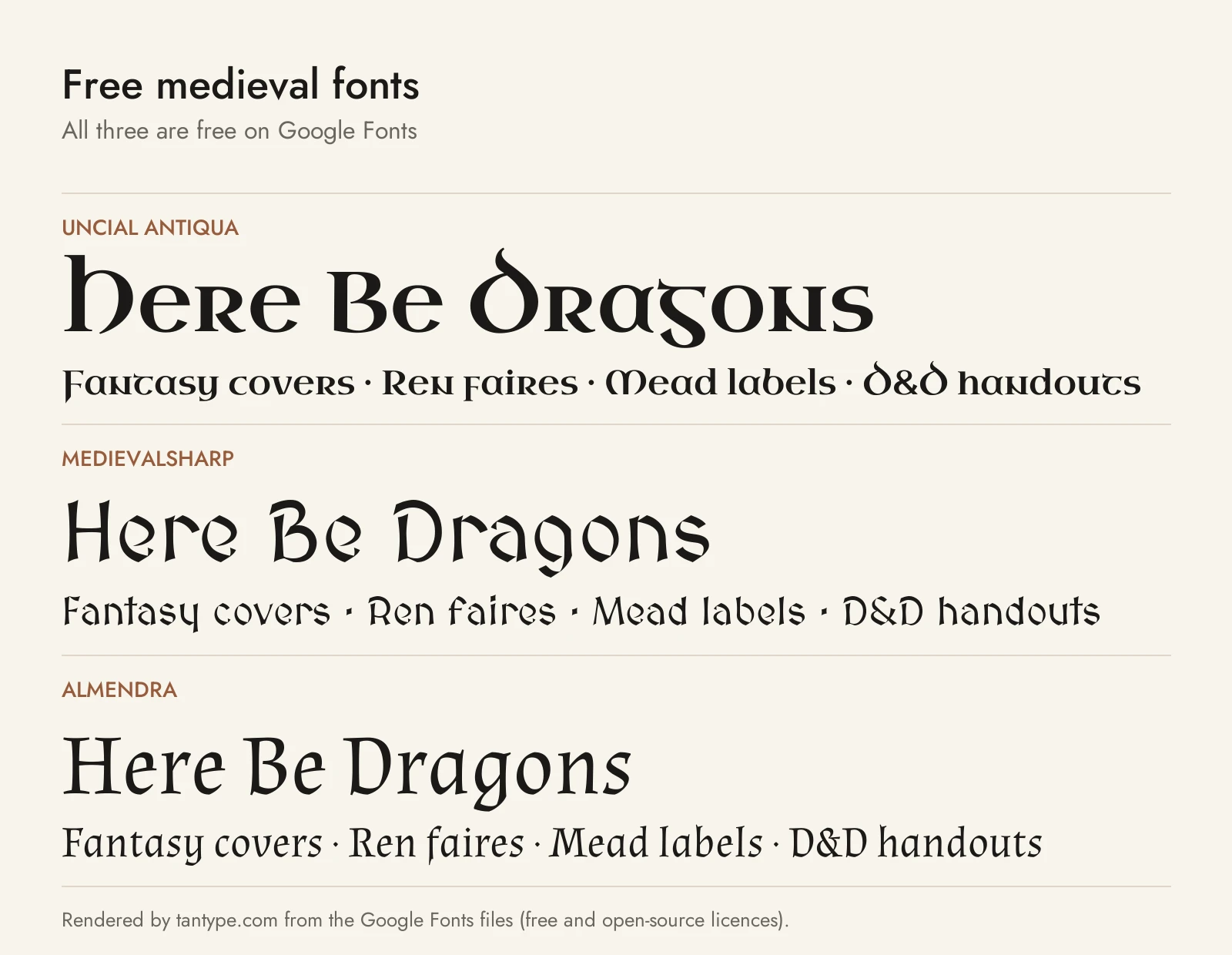
All six allow commercial use. The first five are on Google Fonts under the SIL Open Font License; Junicode is distributed by its designer on GitHub under the same licence. The first three are shown above.
- Uncial Antiqua by Astigmatic combines uncial and half-uncial forms into one formal text face that stays readable. It is the free “Celtic font”, smoother and more regular than CS Ravella. Basic Latin only.
- MedievalSharp by Wojciech Kalinowski began around 1995 as lettering for stone inscriptions, based on Gothic letters. It is chiselled rather than penned, so it suits game titles and carved-sign effects.
- Almendra by Ana Sanfelippo is based on calligraphy related to the chancery and Gothic hands and was designed for long texts, especially children’s books. It has an italic and sister Small Cap and Display families.
- Cinzel Decorative by Natanael Gama is based on first-century Roman inscriptions with decorative capitals. Roman rather than medieval, it is the free stand-in for the Renaissance capitals on fantasy posters and fair signs.
- Metamorphous by James Grieshaber (Sorkin Type) mixes Romanesque, Gothic and Renaissance letter shapes and covers most Latin-script languages. A good free face for handouts that must look old but read quickly.
- Junicode by Peter S. Baker was made for medievalists. Its roman is based on a 17th-century Oxford typeface commissioned by Franciscus Junius (Wikipedia), and Junicode 2 follows the Medieval Unicode Font Initiative, with five weights and five widths. It is the text face to pair with any display font here, and it sets þ, ð and ƿ properly.
| Font | Source | Licence | Commercial use |
|---|---|---|---|
| Uncial Antiqua | Google Fonts | SIL OFL 1.1 | Yes |
| MedievalSharp | Google Fonts | SIL OFL 1.1 | Yes |
| Almendra | Google Fonts | SIL OFL 1.1 | Yes |
| Cinzel Decorative | Google Fonts | SIL OFL 1.1 | Yes |
| Metamorphous | Google Fonts | SIL OFL 1.1 | Yes |
| Junicode | Designer’s GitHub | SIL OFL 1.1 | Yes |
Many “free medieval fonts” on download directories are personal-use demos; a book, game or label you sell needs a commercial licence.
Licensing: personal vs commercial use
Creative Market sells four font licence types, set out on its font licence page:
- Desktop: unlimited personal and commercial projects, including printed books, labels and merch; on websites only as images. One seat per user.
- Webfont: embed on your websites, within a pageview limit.
- App: embed in one app or game. A game that renders menus from the font file needs this.
- E-pub: embed in one ebook. A cover saved as an image is desktop use.
Logos and labels. The licence limits fonts in logos and asks you to disclaim the font if you register a logo as a trademark, so read that clause before building a brewery or game studio mark on one. Print-on-demand shops where customers type their own text are not covered. The OFL fonts above allow logos, labels and embedding. Terms change, so check the current licence before you buy. This is general information, not legal advice.
Medieval font FAQ
What font was used in medieval times?
None: medieval books were written by hand, so the “fonts” were scripts. The main ones were uncial and half-uncial, insular script in Ireland and Britain, Carolingian minuscule, and Gothic textura. The first European printers of the 1450s copied Gothic book hands.
What is the medieval Gothic font called?
It is called blackletter, also Gothic script or textura in its most formal form. Other blackletter styles are rotunda, Schwabacher and Fraktur. Fonts sold as “Old English” are usually blackletter too; our best blackletter fonts guide covers them all.
What font is used for Old English?
Old English manuscripts were written mainly in insular script, not the blackletter that “Old English” fonts use today. For a historically fitting look, use an insular or uncial face. To type the actual language, with þ, ð, ƿ and æ, use Junicode, which was built for medievalists.
What font is the Book of Kells written in?
The Book of Kells was handwritten in insular majuscule around 800, according to Trinity College Dublin. No font copies it exactly, but Celtic fonts such as CS Ravella, Celtoria and the free Uncial Antiqua come close in spirit.
What font does D&D use?
The fifth-edition books use several commercial typefaces rather than one. Fan font projects such as Solbera’s D&D fonts identify Modesto Bold Condensed for titles, Mrs Eaves Small Caps for headings and Bookmania for body text, and offer free look-alikes under CC BY-SA 4.0 for homebrew. For your own published game, choose a font whose licence covers it.
What font is used for The Lord of the Rings?
It depends on the edition or film. Ralph Bakshi’s 1978 animated film used title lettering loosely based on Victor Hammer’s Hammer-Unziale, with American Uncial for Tolkien’s name, according to Fonts In Use. Later film and game logos are trademarks, not fonts.
Are medieval font generators real fonts?
No. Most “medieval font generator” sites swap your letters for Unicode look-alike characters, such as the mathematical Fraktur letters, or render an image. Screen readers treat them as symbols, so for print, games or a logo install a real font.
Is there a free medieval font for commercial use?
Yes. Uncial Antiqua, MedievalSharp, Almendra, Cinzel Decorative and Metamorphous are on Google Fonts under the SIL Open Font License, and Junicode uses the same licence. All allow commercial use.
