
Graffiti Font: 12 Best Graffiti Fonts for Tags, Throw-Ups and Streetwear
A good graffiti font gives you the look of spray-painted street lettering without picking up a can: fast marker tags, puffy throw-ups, layered pieces and sharp, interlocking wildstyle. Graffiti fonts are display typefaces drawn from that lettering, made for logos, streetwear, music covers and posters.
If you only try three, start with Graffiti Wildstreet for layered, two-colour pieces, Street Tag Vol2 for a tag that people can still read and Defase, a seven-font throw-up family from the specialist foundry Graffiti Fonts. All twelve picks are commercial fonts sold on Creative Market, so they need a licence. Six free graffiti fonts that you can use commercially are further down.
See graffiti fonts on Creative Market Commercial fonts; one-seat desktop licences for these picks are $14 to $50 at regular price (October 2026)
What is a graffiti font?
A graffiti font is a display typeface drawn to look like the lettering of spray-paint and marker graffiti: fast tags, puffy throw-ups, blocky straight letters and interlocking wildstyle pieces. It turns a writer’s hand-drawn style into a keyboard alphabet, so it suits short, large text such as logos, titles and shirts.
No font is the real thing: writers draw every letter by hand, while a font repeats the same shapes. The best ones get close with alternates, drips, outlines and layered shadows.
Where graffiti lettering comes from
Modern graffiti grew up in Philadelphia and on the New York City subway in the 1960s and early 1970s, according to Wikipedia’s graffiti article. Tags came first. Philadelphia’s Cornbread is often called the first “king”, and in New York a foot messenger who wrote TAKI 183 around the city was the subject of a New York Times article on July 21, 1971, “‘Taki 183’ Spawns Pen Pals”, which named imitators such as Joe 136 and Barbara 62. Hundreds more followed, and the subway trains became the place to be seen.
Letters soon grew bigger. Phase 2 of the Bronx is generally credited with the “bubble letter” or “softie”, which he first used in late 1972; he is also credited with pioneering arrows in graffiti writing. Around 1974, Tracy 168 and his Wild Style crew gave a name to the most complex lettering of all, and Wikipedia’s wildstyle article notes it was earlier called “mechanical letters” and that Phase 2 is also credited as one of its first writers.
Because trains were cleaned, the era survives mostly in photographs. Martha Cooper and Henry Chalfant’s Subway Art (1984) became known as “the bible” of graffiti, the 1983 documentary Style Wars tied it to early hip-hop, and the Museum of the City of New York’s 2014 show City as Canvas displayed sketchbooks and canvases by writers such as Lady Pink and Futura 2000. Google’s free font Sedgwick Ave is even named after the Bronx street where DJ Kool Herc’s party at 1520 Sedgwick Avenue on August 11, 1973 is credited with starting hip-hop.
Tag, throw-up, piece and wildstyle: the four kinds of graffiti letters
Writers sort their lettering by how long it takes and how hard it is to read, and most graffiti fonts copy one of these forms.
- Tag. A stylised signature, usually in one colour, written fast with a marker or spray can. Wikipedia’s tag article says tags are usually only 3–5 letters long, and that a writer’s personal style is called a handstyle. A graffiti tag font copies that quick, single-stroke look.
- Throw-up. A quick name in big bubble letters. The glossary of graffiti says a throw-up “generally consists of a one-color outline and one layer of fill-color”; one with an outline and no fill is a “hollow”. Bubble letter fonts come from here; see our best bubble fonts.
- Piece. Short for masterpiece: a large, many-coloured painting of letters with 3D effects, highlights, arrows and sometimes characters. Graffiti fonts with layered fill, outline and shadow styles are built for this look.
- Wildstyle. The most complex piece, with letters so stretched, interlocked and decorated with arrows and spikes that outsiders often can’t read them. Wikipedia calls it “the most difficult graffiti style to master”. A wildstyle font is a compromise: it keeps the sharp, interlocking feel but stays readable.
Two more forms show up in fonts. Straight letters, or blockbusters, are big, simple, legible blocks, often rolled on with paint. Stencils, cut from card and sprayed, became common in street art after Blek le Rat’s work in Paris in the early 1980s; see our best stencil fonts, and our punk rock fonts for the sprayed slogans of anarcho-punk.
Graffiti font vs street art font vs spray paint font
A graffiti font is about letters and a writer’s name. A street art font is wider, covering stencils, posters and sign-style lettering too. A spray paint font copies the tool rather than the style: soft edges, overspray and drips, applied to any letter shape. Drippy paint-marker tags are covered in our best marker fonts.
The best graffiti fonts at a glance
| Font | Best for | Styles | Desktop price* |
|---|---|---|---|
| Graffiti Wildstreet | Layered pieces, posters | 2 layers (Fill, Line) | $25 |
| Street Tag Vol2 | Readable tags, streetwear | 1 with alternates | $20 |
| Defase | Layered throw-ups | 7 (5 stackable + 2 colour SVG) | $50 |
| Handtag | Bold all-caps tags | 1 (capitals only) | $15 |
| Tag Play | Tags in upper and lowercase | 1 with ligatures | $18 |
| Lusk Drip | Drippy marker tags | 2 (Regular, Italic) | $22 |
| Wild Mark | Semi-wildstyle titles | Regular + Shadow | $29 |
| Streetmark | Brush tags with drop shadow | 2 (Regular, Shadow) | $20 |
| Spray Cult | Blocky mural-style pieces | 1 | $14 |
| Gravfo | Skate and streetwear graphics | 1 | $24 |
| Smackles | Street brush headlines | 1 | $19 |
| Blackhawk | Fast brush logos, apparel | Regular, Italic + extras | $18 |
*One-seat desktop licence on Creative Market, checked October 2026.
How we chose these fonts
We started from Creative Market’s graffiti, tag and bubble graffiti listings and the graffiti fonts tantype has already reviewed, then checked every listing live on 22 October 2026 for the regular one-seat Desktop price, styles, alternates, file formats and language support. Each pick had to match a real graffiti form: tag, throw-up, piece, wildstyle or street brush. We favoured fonts with layers or alternates, since repeated identical letters give a fake away, and skipped fonts already picked in our bubble, 90s, marker and punk roundups. We ignored shop-level ratings. Descriptions draw on the listings and our existing reviews.
Best graffiti fonts on Creative Market
Prices are the regular one-seat desktop licence on Creative Market, checked on October 22, 2026. Shops run sales often, so check the listing before you buy.
1. Graffiti Wildstreet
Graffiti Wildstreet, from Tomatstudio, is the closest pick to a painted piece. The listing says it is “inspired by the raw, energetic markings found on real urban walls” and was designed by a street artist. You get two OTF files, Wildstreet-Fill and Wildstreet-Line, meant to be stacked: set the word twice, colour each layer, and you have a two-colour piece. Its angular letters lean toward semi-wildstyle but stay readable. Use it for posters, album art and hip-hop event titles. Desktop licence: $25.
See Graffiti Wildstreet on Creative Market
2. Street Tag Vol2
Street Tag Vol2 is the second volume of Tomatstudio’s tag series, inspired by tagging in big cities and, in the designer’s words, “more bold and readable” than the first. Alternate glyphs stop repeated letters looking stamped, and bonus Illustrator files add an outlined alphabet plus drips, spray effects and tag symbols. Use it for streetwear slogans, mixtape covers and social graphics. Desktop licence: $20.
See Street Tag Vol2 on Creative Market
3. Defase
Defase comes from Graffiti Fonts, a foundry that only makes graffiti type, and it is the most complete throw-up font here. The listing calls it a “throwie style font family” of seven typefaces: five stackable layers (Solid Fill, Rough Fill, Outline, Inner Outline and Outer Outline) and two full-colour SVG fonts. Stack a fill under two outlines for a classic throw-up in seconds. The colour fonts need Photoshop CC 18.0, Illustrator CC 22.0 or InDesign CC 13.0.1 or later. For softer puffy styles, see our best bubble fonts. Desktop licence: $50.
4. Handtag
Handtag, from the yktypstd shop, is a heavy all-caps graffiti font that the listing says “captures the raw energy and attitude of street art”. It covers capitals A–Z, numbers and punctuation in OTF and TTF, and is aimed at hangtags, posters, labels, apparel and titles. With no lowercase, it works best on words of three to six letters, about how long real tags are. Set it big with tight tracking so letters touch. Desktop licence: $15.
See Handtag on Creative Market
5. Tag Play
Tag Play, by BB Type Studios, is a “bold hand-drawn display font inspired by street graffiti” with both uppercase and lowercase letters. Ligatures and multilingual support are included, in OTF, TTF and WOFF, so it handles accented names and a short line of text as well as a single word. The listing suggests posters, music covers, streetwear, YouTube thumbnails and sports graphics. Desktop licence: $18.
See Tag Play on Creative Market
6. Lusk Drip
Lusk Drip, from Indotype Foundry, is “a caps graffiti display font” with marker-style strokes, exaggerated letterforms and paint drips running off the letters. It comes in Regular and Italic, and the italic gives the forward lean of a tag written at speed. Numbers, symbols and accents are included, with multilingual support, in OTF, TTF and WOFF. Drips read as wet paint, so it suits streetwear, music visuals and event flyers. Desktop licence: $22.
See Lusk Drip on Creative Market
7. Wild Mark
Wild Mark, by Ditatype, is an all-uppercase graffiti font that the listing calls “an expressive graffiti font that radiates untamed energy”, with irregular letter shapes and a shadow style for depth: a readable cousin of wildstyle. Alternates, numerals, punctuation and multilingual support are included, in OTF and TTF. Stack the shadow in a dark colour behind a bright face for a 3D piece look. Use it for gaming thumbnails, sneaker drops and event branding. Desktop licence: $29.
See Wild Mark on Creative Market
8. Streetmark
Streetmark, by Eric Kurniawan of Burntilldead, is “a graffiti font inspired by street vibes and dynamic energy” in Regular and Shadow. It covers upper and lowercase, numbers, punctuation, alternates, ligatures and multilingual characters, in OTF, TTF and WOFF. The Shadow style sits behind the Regular like the drop shadow writers add to make a tag pop off a wall. It is not the same font as Grovestreet, the designer’s drippy marker in our best marker fonts. Desktop licence: $20.
See Streetmark on Creative Market
9. Spray Cult
Spray Cult, from Jelek Type, is a heavy display face “inspired by street art and graffiti culture”, with letters built from fragmented, blocky cuts, interlocking segments and sharp angles, the way large spray-painted mural letters are blocked out. It sits between straight letters and a piece, so it stays readable from across a room. The listing points it at posters, album covers and skateboarding brands. Desktop licence: $14, the lowest here.
See Spray Cult on Creative Market
10. Gravfo
Gravfo, by Catalystco Studio, is a “bold and expressive graffiti-style typeface” that draws on street art and skate culture, with brush-like strokes, natural slants and irregular letter shapes. It covers upper and lowercase, numerals, punctuation, symbols and multilingual characters, in OTF, TTF and WOFF. It is the most relaxed pick here. Use it for streetwear, skate shop logos and music promotion. Desktop licence: $24.
11. Smackles
Smackles, from ikiiko, is a street brush font whose “rough brush strokes add a handmade feel”. Upper and lowercase, numbers, punctuation and multilingual support come in TTF and OTF, and the listing suggests posters, streetwear, movie titles and magazine layouts. It is street-poster brush lettering rather than a strict tag, so it reads well in a full line. ikiiko also made Rage Machine, the spray-paint script in our best 90s fonts. Desktop licence: $19.
See Smackles on Creative Market · Read our Smackles review
12. Blackhawk
Sam Parrett’s Blackhawk is a “street-wise brush font” in three files: an all-caps Regular with alternate characters, an Italic, and a Swashes font with 11 swashes and 4 paint splatters. Switch between upper and lower case to reach the alternates, so repeated letters can change shape. Multilingual support is included, in TTF and OTF. Use it for logos, apparel and product packaging. Desktop licence: $18.
See Blackhawk on Creative Market
Using graffiti fonts with respect
Graffiti fonts borrow from a living culture with its own rules.
- Don’t present a font as someone’s tag. A tag is a writer’s identity. The tag article notes that using the name of an existing artist in their area is a faux pas, and the glossary defines “biting” as stealing another writer’s name, lettering or colours. Type your own words, and never pass off a font-made logo as a real writer’s or crew’s work.
- Hire a writer for anything that matters. For a mural, shop front or brand built on street credibility, commission a graffiti artist.
- Keep it legal. Painting walls without permission is vandalism in most countries, and no font licence changes that.
How to choose a graffiti font
- Pick the form first. Tag: Street Tag Vol2, Handtag, Tag Play or Lusk Drip. Throw-up: Defase. Piece or semi-wildstyle: Graffiti Wildstreet, Wild Mark or Spray Cult. Street brush: Streetmark, Gravfo, Smackles or Blackhawk.
- Readability beats realism. Real wildstyle is meant to be hard to read; a logo or poster is not. If a friend can’t read the word in two seconds, choose a plainer font.
- Look for layers and alternates. Fill, line and shadow styles build a multi-colour piece; alternates stop identical letters sitting side by side.
- Use it for one thing. Set the name, title or slogan in the graffiti font and everything else in a plain sans or a poster font.
- Check the output. Drips and spray texture fill in when screen-printed or embroidered. Use solid styles for merch.
Where graffiti fonts work
Graffiti fonts suit streetwear slogans, hip-hop and DJ mix covers (check the title at thumbnail size), skate shop and barber branding, and block party or dance battle posters. For west coast lowrider looks, see our Chicano fonts, which grew from the blackletter-based cholo writing of Los Angeles.
How to use a graffiti font in Word, Canva and Cricut
Word. Microsoft’s add a font guide says to extract the .zip, right-click the font files and choose Install; the font appears in Word the next time you start it. For a throw-up look, add a thick text outline in a second colour.
Canva. Canva’s upload fonts guide says font uploads are available on paid plans such as Canva Pro and Teams, in OTF, TTF or WOFF format, so unzip the download first. Upload only fonts you are licensed to embed. For layered fonts like Graffiti Wildstreet, stack two text boxes, one per layer.
Cricut. Install the font on your computer first; Cricut’s Design Space text guide lets you filter the font list to system fonts. Drips and spray speckle cut badly in vinyl, so choose solid styles such as Handtag or Defase Solid Fill, and weld script letters so they cut as one piece.
Free graffiti fonts
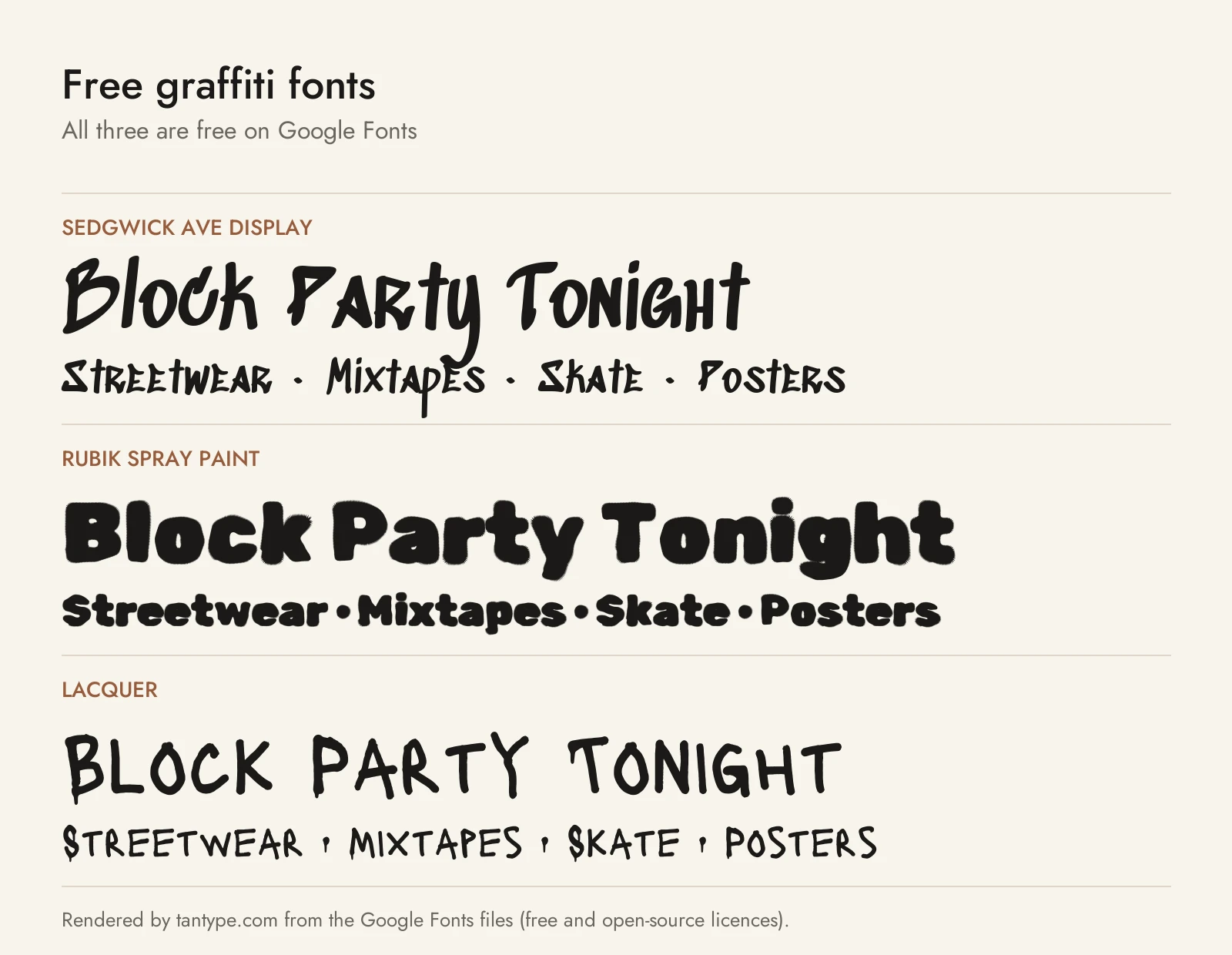
All six are on Google Fonts under the SIL Open Font License, which allows commercial use, including logos, merch and print-on-demand. The first three are shown above.
- Sedgwick Ave Display by Pedro Vergani and Kevin Burke is the closest free thing to a real handstyle. Google’s description says the project “expresses handwritten graffiti letterforms”, and the project page says the fonts celebrate “the letterforms of hip hop culture”. It is lighter than the paid tag fonts.
- Rubik Spray Paint by NaN and Luke Prowse adds sprayed, speckled edges to the sans Rubik. It is a spray paint font rather than a graffiti letter style, good for slogans.
- Lacquer was hand drawn with a paint pen by Niki Polyocan and finished by Eli Block at Google Creative Lab. Heavy drips and dozens of alternates make it the free stand-in for Lusk Drip.
- Sedgwick Ave is the text partner of Sedgwick Ave Display, drawn for captions and smaller sizes.
- Bungee Spice by David Jonathan Ross is a colour font with built-in gradient fills from a family inspired by vertical urban signs. It is signage rather than graffiti, but the fade looks like a sprayed fill; it needs an app that supports colour fonts.
- Rubik Dirt, another NaN and Luke Prowse filter on Rubik, adds grimy, worn texture for a weathered wall look.
| Font | Source | Licence | Commercial use |
|---|---|---|---|
| Sedgwick Ave Display | Google Fonts | SIL OFL 1.1 | Yes |
| Rubik Spray Paint | Google Fonts | SIL OFL 1.1 | Yes |
| Lacquer | Google Fonts | SIL OFL 1.1 | Yes |
| Sedgwick Ave | Google Fonts | SIL OFL 1.1 | Yes |
| Bungee Spice | Google Fonts | SIL OFL 1.1 | Yes |
| Rubik Dirt | Google Fonts | SIL OFL 1.1 | Yes |
Many “free graffiti fonts” on download directories are personal-use demos that need a paid licence for anything you sell. Rock Salt and Permanent Marker, two other free marker fonts, are covered in our marker fonts roundup.
Licensing: personal vs commercial use
Creative Market sells four licence types, set out on its font licence page:
- Desktop: install the font and use it in unlimited personal and commercial projects, including physical products you sell, with no cap on the number of items. On websites the font may appear only as images. Buy one seat per user.
- Webfont, App, E-pub: embed the font on your websites (within a pageview limit), in one app or game, or in one ebook.
Streetwear and logos. A Desktop licence covers shirts, hoodies, stickers and posters you design and sell. Print-on-demand tools where customers type their own text are not covered, because the end user is not the licensee. A font can be part of a logo only if it is modified and is not the dominant element, and if you register the logo as a trademark you must disclaim the font. Google Fonts’ open licences allow logos and merch with no such limits. Terms change, so read the current licence. This is general information, not legal advice.
Graffiti font FAQ
What is the best graffiti font?
It depends on the form you want. For a layered piece, Graffiti Wildstreet; for a readable tag, Street Tag Vol2; for a throw-up, Defase. The best free graffiti font is Sedgwick Ave Display, which is on Google Fonts under an open licence.
What are graffiti letters called?
Writers name them by form: tags (stylised signatures), throw-ups (quick bubble letters), pieces (large multi-colour paintings), wildstyle (interlocking, hard-to-read pieces) and straight letters or blockbusters (big, plain blocks). A writer’s personal way of writing is their handstyle, and a graffiti letters font usually copies one of these forms.
What is the difference between a tag and a throw-up?
A tag is a signature written in one colour with a single quick line. A throw-up is bigger, with bubble letters drawn as an outline and filled with a second colour.
Is there a graffiti font in Word?
No standard Office font is a true graffiti font, so install one: download a free font such as Sedgwick Ave Display from Google Fonts or a licensed font from Creative Market, unzip it, right-click and choose Install, then restart Word.
Where can I get a graffiti alphabet?
Install a graffiti font and type A–Z to see the full graffiti alphabet, including numbers and alternates. To practise by hand, print it large, trace it, then start changing the shapes until they become your own.
Are graffiti font generators real fonts?
No. Most “graffiti font generator” sites either render your word as an image or swap your letters for Unicode look-alike characters you can paste into social bios. Nothing is installed, and commercial rights are usually unclear. For print, merch or a logo, use a real font file.
Can I use a graffiti font for a clothing brand or logo?
Yes, with the right licence. Creative Market’s Desktop licence covers products you sell, but limits how a font can be used in a trademarked logo; Google Fonts’ open licences have no such limit. Don’t design a logo that copies a real writer’s tag or crew name.
